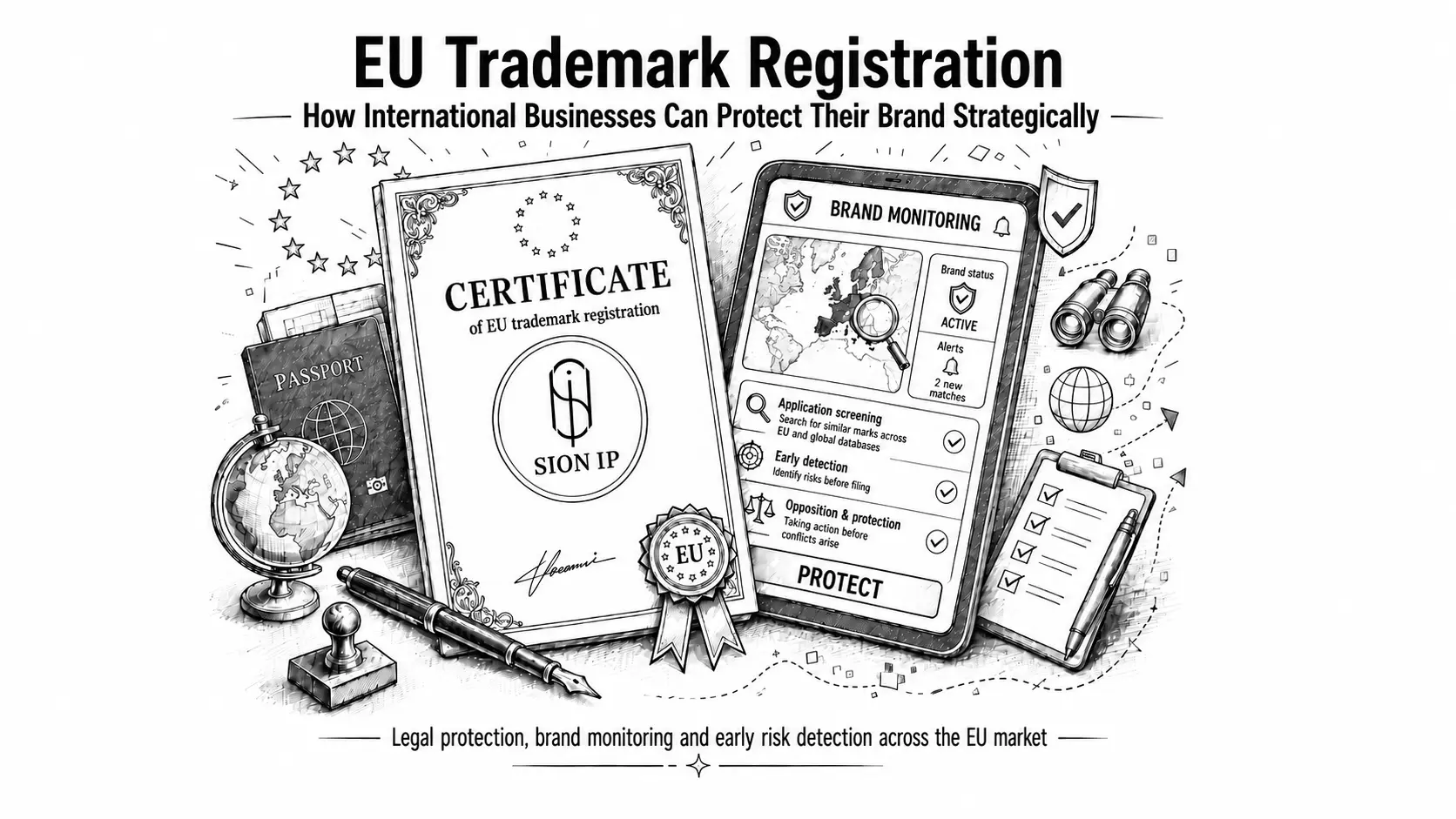
EU Trademark Registration: How International Businesses Can Protect Their Brand Strategically
Natalia Riazanova
EU trademark registration is often viewed as a straightforward administrative step: choose a brand name, file an application, pay the official fee, and wait for registration. For international businesses, however, the decision is rarely that simple. Trademark protection in the EU is also a question of budget, timing, commercial geography, earlier-rights risk, class coverage, marketplace strategy, and long-term brand expansion.
The European Union Intellectual Property Office, or EUIPO, allows businesses to file one application for a European Union Trade Mark, also known as an EUTM, which can protect a mark across all EU member states. This may look like the most efficient option: one application, one procedure, one official fee structure, and EU-wide protection. EUIPO confirms that an EU trade mark gives protection throughout the EU, while a national trademark protects only the member state in which it is registered.
However, an EUTM is not always the best route. If a business operates only in Germany, France, Spain, Italy, Poland, the Netherlands, or another specific EU country, national trademark registration may sometimes be more rational. The EUTM has a unitary character, meaning it functions as one right across the European Union. Regulation (EU) 2017/1001 states that an EU trade mark has equal effect throughout the Union and generally cannot be registered, transferred, surrendered, revoked, declared invalid, or prohibited except for the whole EU.
This is powerful when registration succeeds. It is risky when an earlier right exists in one EU country. A conflict with earlier national rights in a single member state may create risk for the entire EU trademark application.
The key question is: how can an international business register a trademark in the EU in a way that protects the brand, avoids unnecessary costs, and reduces the risk of refusal, opposition, or conversion of the application?
Why EU Trademark Registration Requires a Strategic Approach
EU trademark registration should not be treated as a simple filing form. The EU operates as a single economic market in many commercial respects, but trademark rights still exist within a layered legal environment: EU-wide rights, national rights, earlier unregistered rights in some jurisdictions, company names, domain names, marketplace use, and sector-specific branding practices.
A mark may appear available in one country but conflict with an earlier national trademark in another. For example, a SaaS company may clear its brand in France and the Netherlands but overlook a similar earlier trademark in Poland. A cosmetics brand may focus on Germany, France, Italy, and Spain but face opposition from a smaller national trademark owner in another EU country. An e-commerce seller may think only about its country of incorporation, while its Amazon, Zalando, Allegro, or eBay listings create commercial exposure across several EU markets.
A strong EU trademark strategy should reflect real and planned business markets, not simply “maximum territory.” Broad protection is useful only when it is commercially relevant and legally achievable. The cheapest or fastest filing route is not always the safest.
Before filing an EU trademark application, international businesses should assess:
- earlier trademark rights in EUIPO and national databases;
- countries of actual and planned sales;
- marketplace presence and cross-border shipping;
- distributor, manufacturing, and logistics locations;
- Nice Classification classes;
- visual, phonetic, and conceptual similarity;
- language risks across EU countries;
- likelihood of confusion;
- opposition probability;
- budget for filing and possible disputes;
- future brand expansion.
Poor planning may lead to opposition, delays, negotiations, narrowing of goods and services, conversion into national applications, or repeat filing. A strong EU trademark strategy starts before filing — with a clear understanding of markets, classes, earlier rights, opposition risks, timing, and budget.
EUIPO Registration vs National Trademark Registration: What Is the Difference?
International businesses usually choose between two main routes: national trademark registration in EU countries or EUIPO trademark registration for a European Union Trade Mark.
A national trademark protects the mark only in the selected country. EUIPO trademark registration may protect the mark across the entire EU through one centralized application. EUIPO is often efficient for broad geographic coverage, especially where a brand will be used in several EU countries. National registration may be more flexible and safer where the business is entering only one or two markets or where earlier-rights risk is concentrated in certain countries.
The central point is the EUTM’s unitary character. It creates efficiency, but it also means that a problem in one member state may affect the whole EUTM registration strategy.
| Criteria | National trademark registration | EUIPO trademark registration |
| Territory of protection | One selected EU country | All EU member states |
| Number of applications | Separate application per country | One EU-wide application |
| Budget | May be lower for one or two countries | Often more efficient for several countries |
| Opposition risk | Usually limited to the selected country | A conflict in one country may affect the whole EUTM |
| Flexibility | Higher | Lower because of unitary character |
| Best for | Local or phased market entry | EU-wide expansion |
| Refusal consequences | Usually limited nationally | May affect EU-wide registration |
| Portfolio management | More complex if many countries are involved | Centralized and simpler |
Practical takeaway: EUIPO registration can be cost-effective for broad EU protection, but national registration may be more strategic when the business operates in limited markets or when earlier rights create risk in specific countries.
National Trademark Registration in EU Countries
National trademark registration means filing directly with the trademark office of a specific EU country. Each member state has its own national procedure, official fees, examination practices, language requirements, and procedural rules.
A national trademark protects the mark only in that country. Registration in Germany, for example, does not automatically protect the brand in France, Italy, Spain, Poland, or the Netherlands. This reflects the territorial nature of trademark rights. INTA explains that international trademark rights are generally rights across different jurisdictions, and their existence and enforceability are usually unique to each jurisdiction.
When National Trademark Registration Makes Sense
National trademark registration in EU countries may be appropriate when:
- the company operates only in one EU country;
- the business is testing one market before expanding;
- the brand may conflict with earlier rights in other EU countries;
- the company wants to reduce the risk of blocking an EU-wide application;
- the budget is limited;
- the commercial launch is local or phased;
- the business wants to isolate risks by jurisdiction.
Example: A brand plans to sell only in Spain and Portugal, while a preliminary search identifies a similar trademark in Poland. An EUIPO application may expose the brand to unnecessary opposition risk, while national applications in the priority markets may protect the real commercial territory more safely.
Advantages of National Trademark Registration
National trademark registration provides precise territorial protection. It allows a company to protect the countries where the brand is actually used, rather than seeking EU-wide coverage immediately.
It can also isolate risk. If a national application faces refusal or opposition in one country, that issue does not automatically block protection in another country. This can be important for phased market entry, local launches, distributor-led expansion, or brands with higher conflict risk in certain EU territories.
For one or two markets, national registration may also be more cost-effective than EUIPO trademark registration, depending on the official fees, professional fees, language requirements, and risk profile.
Limitations and Risks of National Trademark Registration
National filings become more complex as the number of countries increases. Costs may rise quickly if several applications are needed. Procedures and timelines differ. Local representatives may be required in certain situations. Translations may be needed. Renewals, monitoring, ownership changes, and portfolio management must be handled across several jurisdictions.
National trademark registration is not a weaker strategy. In many cases, it can reduce risk, isolate conflicts, and align trademark protection more accurately with the company’s actual markets.
EUIPO Trademark Registration
EUIPO is the European Union Intellectual Property Office, responsible for managing EU trade marks and registered EU designs. An EUIPO application may result in a European Union Trade Mark, which provides protection across the EU through one registration. EUIPO describes an EUTM as a trade mark valid throughout the entire EU where a business operates in more than one EU country.
EUIPO trademark registration offers procedural concentration: one application, one procedure, one official fee structure, one registration, and one renewal cycle. This is particularly attractive for international businesses, e-commerce brands, exporters, SaaS companies, manufacturers, and businesses using distributors in several EU countries.
Main Advantages of EUIPO Registration
EUIPO registration can provide:
- EU-wide trademark protection;
- one centralized application;
- easier portfolio administration;
- potential cost efficiency for multi-country expansion;
- a clear official fee structure;
- usefulness for marketplace and cross-border brand protection;
- centralized brand enforcement planning.
As of the current EUIPO fee schedule checked in May 2026, the basic online application fee is €850 for one class, the second class costs €50, and the third and each additional class costs €150 per class. EUIPO also states that an EU trade mark is valid for 10 years and can be renewed indefinitely for additional 10-year periods.
When EUIPO Registration Is Especially Suitable
EUTM registration is usually suitable when:
- the brand is sold or planned to be sold in several EU countries;
- the company uses European marketplaces;
- the business works with distributors across the EU;
- multiple national filings would be more expensive or administratively complex;
- centralized portfolio management is important;
- the brand is strategically important for international scaling;
- a preliminary trademark clearance search EU does not reveal critical conflicts.
Example: A cosmetics manufacturer plans to sell in Germany, France, Italy, Spain, and the Netherlands. In this case, one EUTM application may be more commercially efficient than five separate national applications, provided that the clearance search does not reveal serious earlier-rights risks.
Limitations and Risks of EUIPO Registration
The main limitation of EUIPO trademark registration is the EUTM’s unitary character. A conflict in one EU country may affect the entire application. Earlier national trademarks may be used as a basis for opposition. EUIPO examination does not automatically eliminate all business risks connected with earlier rights. A mark may pass initial examination and still face opposition after publication.
Incorrect class selection may increase opposition risk. Linguistic, phonetic, and conceptual issues may arise across EU markets. A word that is distinctive in one language may be descriptive, misleading, offensive, or conceptually similar to another mark in another language.
Practical takeaway: EUIPO registration is often economically attractive, but only when supported by a preliminary risk assessment. Without that assessment, a single EU-wide application can become a source of additional costs.
The Main Hidden Risk: Why a Conflict in One EU Country Can Affect the Whole EUTM
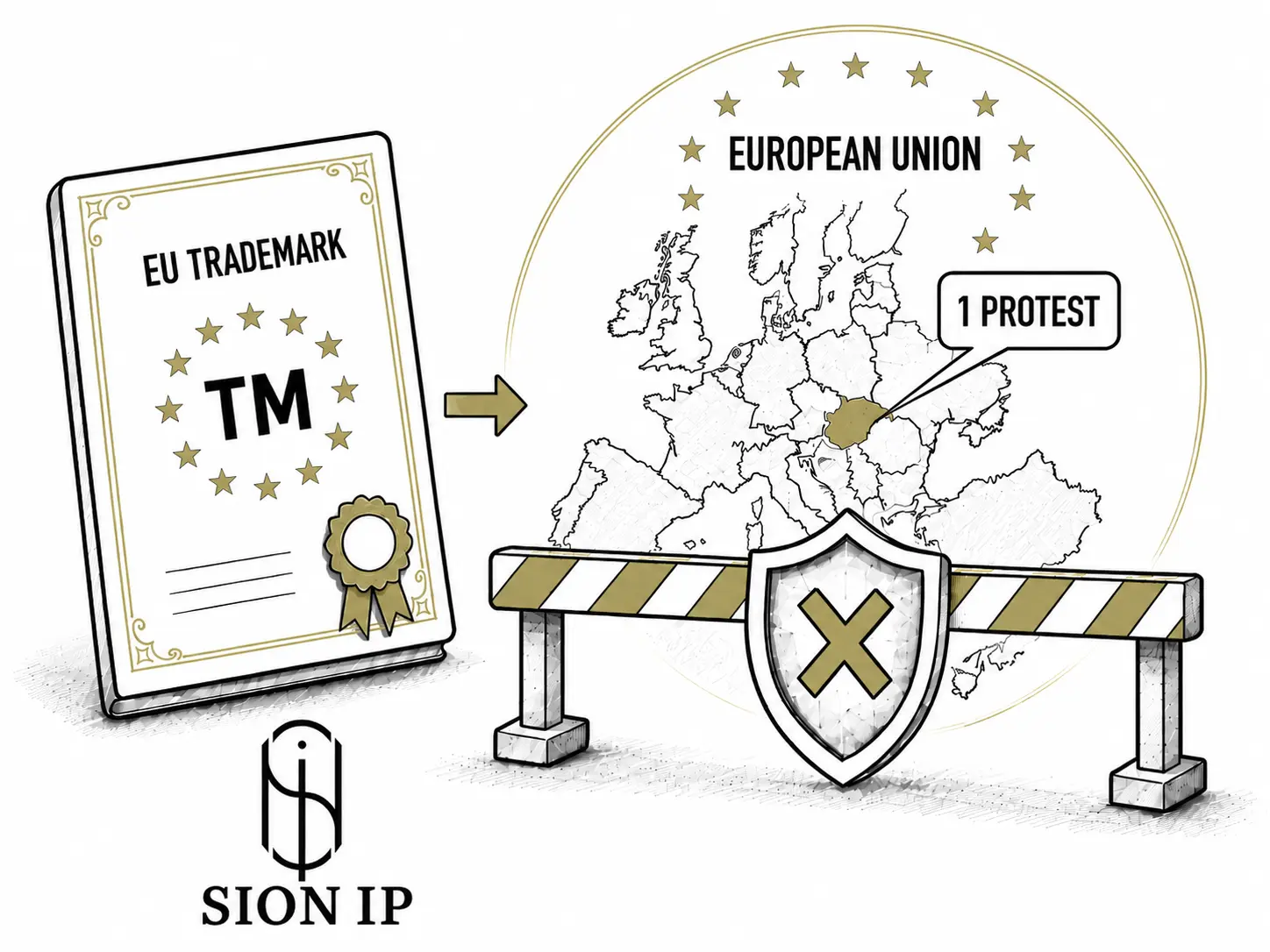
The European Union Trade Mark operates as one single right across the EU. This is convenient when registration succeeds. It is also the key hidden risk of EUIPO trademark registration.
If an earlier national trademark exists in one EU country, the owner of that earlier right may oppose the EUTM application. Even if that country is not commercially important for the applicant, the opposition may still affect the EU-wide application because the applicant requested one unitary EU trademark.
EUIPO confirms that after publication of an EU trademark application, a three-month opposition period begins, during which a party with an earlier right may object to registration.
Practical scenario: A company files an EU trademark application for a new cosmetics brand. Its main markets are Germany, France, Italy, and Spain. The business does not plan active sales in a smaller EU country. However, a similar national trademark already exists there for similar goods.
After publication of the EUTM application, the owner of the earlier national mark files an opposition. Even though the applicant does not consider that country commercially important, the conflict may affect the entire EUIPO application because the applicant requested one unitary EU trademark.
Possible consequences include:
- the procedure may be delayed;
- legal and professional costs may increase;
- the applicant may need to respond to the opposition;
- the list of goods and services may need to be narrowed;
- negotiations or a coexistence agreement may be required;
- the application may be refused fully or partially;
- conversion into national applications may be considered;
- the total project budget may increase.
The most expensive risk in EU trademark registration is often not the official filing fee, but an unprepared application that faces opposition after publication.
What Is EU Trademark Opposition?
EU trademark opposition is a procedure where the owner of earlier rights objects to the registration of a new trademark application. It may be based on earlier national trademarks, earlier EUTMs, or other relevant earlier rights, depending on the case.
The typical basis is likelihood of confusion. This may involve similarity between the signs, similarity between the goods or services, and the overall commercial impression created by the marks.
Opposition occurs after publication of the EU trademark application. If opposition is rejected, the application may continue toward registration. If opposition succeeds, the application may be refused fully or partially.
It is important not to misunderstand EUIPO examination. EUIPO does not function as a full business-risk clearance service for applicants. A trademark may pass initial examination but still face opposition from an earlier rights owner after publication. EUIPO explains that if someone owns an earlier right and believes there is a conflict, they can oppose the application.
Practical takeaway: A clearance search before filing is not a formality. It helps estimate the probability of opposition and the possible budget required to defend the application.
What Should Be Checked Before Filing an EU Trademark Application?
Before filing an EU trademark application, businesses should conduct due diligence that combines legal and commercial analysis.
A practical trademark search EU checklist should include:
- identical and similar trademarks in EUIPO databases;
- earlier national trademarks in priority EU countries;
- visual, phonetic, and conceptual similarity;
- similarity of goods and services;
- Nice Classification classes;
- descriptive or non-distinctive meanings in EU languages;
- potentially misleading meanings;
- countries of current sales;
- countries of planned sales in the next one to three years;
- marketplace presence;
- competitors and prior brands;
- distributors and manufacturing locations;
- possible opposition risk;
- budget for official fees and potential disputes;
- need for professional representation;
- backup options if the EUTM route fails.
A good filing strategy should be based on commercial geography, legal risk, class coverage, and future expansion plans — not only on the desire to obtain the broadest possible protection.
Proactive Strategies to Reduce EU Trademark Registration Risks
1. Conduct a Preliminary Trademark Search
A preliminary trademark clearance search EU should cover both identical and similar marks. It should include the EUIPO database and national trademark databases in relevant EU countries.
The search should assess:
- identical signs;
- visually similar signs;
- phonetically similar signs;
- conceptually similar signs;
- similarity of goods and services;
- strength of earlier marks;
- real risk of confusion.
For word marks, language issues are especially important. A sign may be neutral in English but descriptive, misleading, offensive, or conflicting in another EU language.
2. Identify Commercially Important Markets
The applicant should define:
- where the brand is already used;
- where sales are planned in the next one to three years;
- where competitors operate;
- which marketplaces are used;
- where distributors are located;
- where manufacturing and logistics are based.
A business may not need EU-wide protection immediately if the actual commercial launch is limited to one country.
3. Choose Between EUIPO, National Filings, or a Combined Strategy
EUIPO may be suitable for broad, low-risk EU expansion. National filings may be safer where the business targets specific countries or where conflicts exist elsewhere. A combined strategy may protect priority markets first and leave EU-wide expansion for a later stage.
Example: A company may file national applications in Germany and France first because those are the current sales markets, and later consider an EUTM after additional clearance work.
4. Select Nice Classification Classes Correctly
Class selection matters because it affects both protection and risk. Too broad a list may increase opposition risk. Too many classes may increase official fees. Too narrow a list may fail to protect real or planned business activities.
The Nice Classification has 45 classes: classes 1 to 34 cover goods, and classes 35 to 45 cover services. EUIPO recommends using TMclass to select pre-defined goods and services terms from the Harmonised Database, as those terms have already been accepted by EUIPO.
As of 1 January 2026, the 13th edition of the Nice Classification, Version 2026, applies to trademark applications filed from that date.
5. Assess Negotiation and Coexistence Options
A similar earlier mark does not always mean the application must be abandoned. Depending on the facts, possible solutions may include:
- narrowing goods and services;
- negotiating with the earlier rights owner;
- coexistence agreement;
- consent or settlement, where appropriate;
- choosing a modified filing strategy.
These options depend on the owner of the earlier right, similarity of marks, similarity of goods or services, actual use, commercial interest, and jurisdiction-specific issues.
6. Prepare a Backup Plan: Conversion
Conversion is the process of turning a European Union Trade Mark application or registration into one or more national applications. EUIPO Guidelines describe conversion as converting an EUTM application or registration into national applications.
If an EUTM application fails or cannot proceed EU-wide, conversion into national applications may sometimes be available. It may preserve the original filing date in countries where the obstacle does not apply. However, conversion is not a cost-free rescue mechanism. It usually increases budget and complexity and should be treated as a backup option, not the primary strategy.
A proactive EU trademark strategy does not simply help file an application. It helps manage conflict probability, timing, cost, and the likelihood of obtaining commercially useful protection.
Cost Planning and Budget Optimization for EU Trademark Registration
Budget optimization is not the same as choosing the cheapest filing route. A realistic EU trademark cost analysis may include:
- official EUIPO or national office fees;
- professional fees;
- preliminary trademark search;
- preparation of goods and services;
- translations, if needed;
- responses to office actions;
- opposition defense;
- negotiations with earlier rights owners;
- coexistence agreements;
- conversion into national applications;
- renewals;
- monitoring of later trademark applications;
- trademark portfolio management.
Why Cheap Filing Can Become Expensive
A low-cost filing without proper search may lead to:
- opposition;
- delay;
- additional professional fees;
- narrowed protection;
- need to refile;
- conversion expenses;
- settlement or coexistence negotiations;
- loss of time during market entry.
Example: If a brand needs protection only in one EU country but files an EUTM without a search, it may face opposition from a trademark owner in a country where the business never planned to operate. The initial saving on analysis may turn into higher dispute costs.
Practical Budgeting Logic
For one country, compare national filing with EUIPO filing. For three or more countries, EUIPO may often become economically attractive, but this depends on risk. For high-risk marks, a national or phased strategy may be better.
For e-commerce, the relevant territory is not only the company’s country of incorporation. The relevant markets are also where customers can buy the goods, where marketplace listings appear, where advertising is targeted, and where distributors or logistics partners operate.
Effective budget planning should be based on the relationship between territory, risk, cost, timing, and commercial priorities — not only on the lowest official filing fee.
EUIPO or National Trademark Registration: How to Choose the Right Strategy
Before filing, the business should answer:
- In which EU countries is the brand already used?
- Where are sales planned in the next one to three years?
- Will the company sell through Amazon, Zalando, Allegro, eBay, or other marketplaces?
- Are there identical or similar earlier trademarks?
- Are there specific risks in individual EU countries?
- How many Nice classes are needed?
- Is the mark distinctive enough?
- Is there a budget for opposition if it occurs?
- Is EU-wide protection commercially necessary now?
- Would a phased strategy be more reasonable?
- Is professional trademark support needed before filing?
Strategy 1: EUIPO Application
An EUIPO application is usually suitable if:
- broad EU protection is needed;
- the brand will be used in several EU countries;
- the preliminary search does not reveal critical conflicts;
- centralized portfolio management is important;
- several national filings would be more expensive or complex.
Strategy 2: National Trademark Registration
National trademark registration is usually suitable if:
- the business operates only in one country;
- there is elevated risk in other EU countries;
- the launch is local;
- the budget is limited;
- protection is needed only in a specific market.
Strategy 3: Combined or Phased Strategy
A combined or phased strategy may be suitable if:
- some countries are high priority;
- risk differs across EU countries;
- the business wants to protect core markets first;
- brand expansion is gradual;
- the company needs to balance coverage, budget, and risk.
There is no universal best option. The right trademark strategy depends on sales geography, opposition risk, classes, marketplaces, budget, and long-term commercial plans.
Common Mistakes in EU Trademark Registration
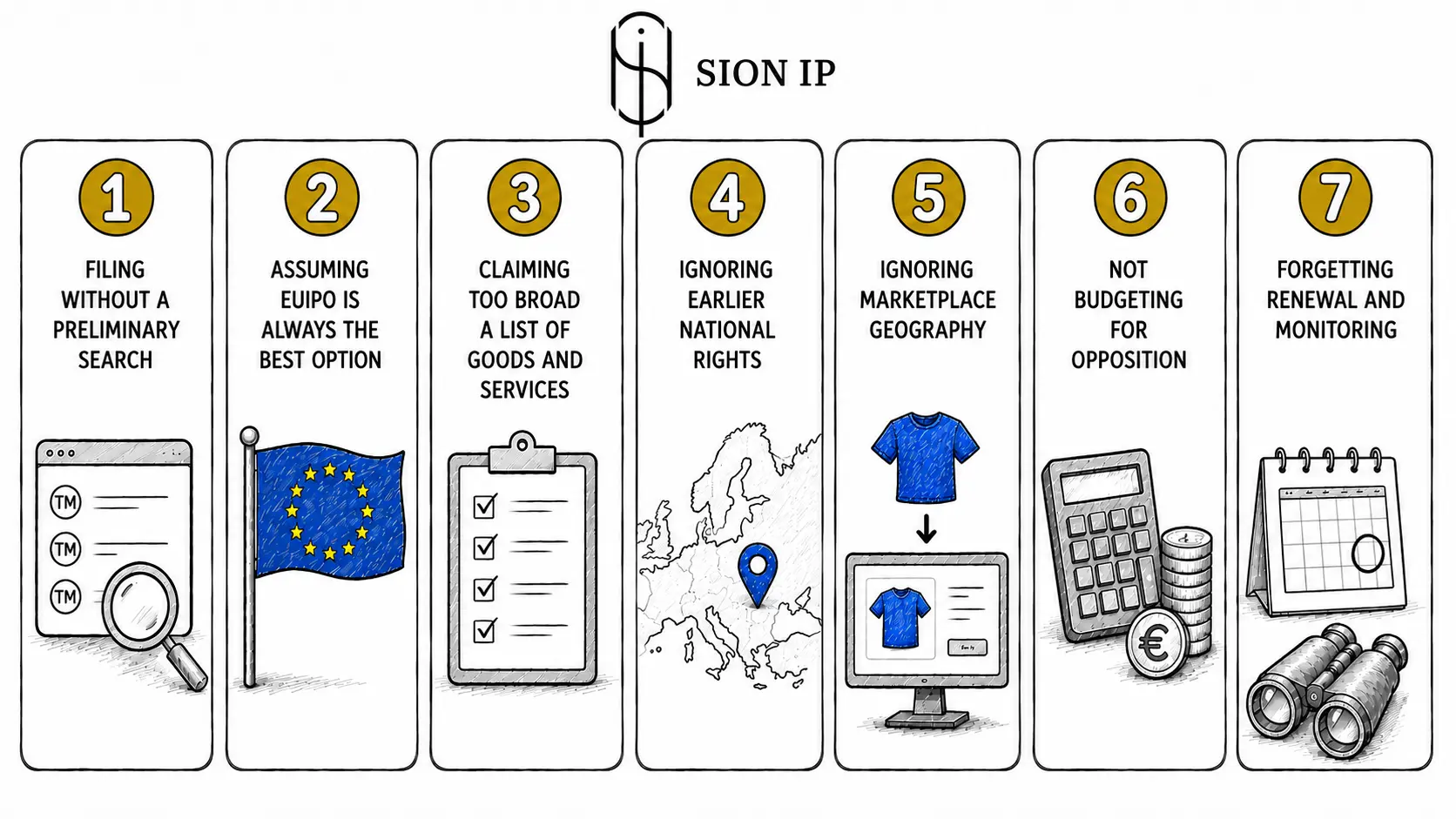
Mistake 1. Filing Without a Preliminary Search
The consequence is a higher risk of opposition, delays, additional costs, and possible refusal. The search should cover not only identical marks, but also similar signs and similar goods or services.
Mistake 2. Assuming EUIPO Is Always the Best Option
A single EU-wide application may be vulnerable because of a local conflict in one country. National registration may sometimes be safer and more commercially rational.
Mistake 3. Claiming Too Broad a List of Goods and Services
Overbroad specifications may increase official fees, raise opposition risk, and create weaker alignment with real business activity. The list should be sufficient but not excessive.
Mistake 4. Ignoring Earlier National Rights
The owner of an earlier national trademark may oppose the EUTM application. Even a right in one EU country may affect the whole EU application.
Mistake 5. Ignoring Marketplace Geography
The trademark may be registered in the wrong territory or fail to cover the countries where sales actually happen. This is particularly relevant for Amazon, Zalando, Allegro, eBay, and cross-border e-commerce.
Mistake 6. Not Budgeting for Opposition
A company may be ready to pay for filing but not ready to defend the application. International clients should consider not only filing fees, but also possible dispute costs.
Mistake 7. Forgetting Renewal and Monitoring
A trademark portfolio may formally exist but fail to protect the brand against later conflicting applications. Monitoring helps identify potential conflicts early and supports active brand protection in Europe.
Why Professional Support Can Save Costs
Professional trademark support can help businesses make filing decisions based on commercial priorities and legal risk, not assumptions.
A trademark specialist can help:
- choose between EUIPO, national, and combined strategies;
- assess earlier rights before filing;
- avoid unnecessary applications;
- select proper classes;
- reduce risk of opposition;
- prepare responses if opposition arises;
- negotiate coexistence where appropriate;
- plan conversion if needed;
- align trademark filing strategy with long-term business goals.
In many cases, cost savings come not from avoiding professional support, but from choosing the right filing route, preparing properly, and identifying risks before they turn into opposition, delays, conversion, or repeated procedures.
Before moving forward with EU trademark registration, it is advisable to assess the available filing routes, expected costs, earlier-rights risks, class coverage, and target markets to choose the most suitable protection strategy.
Conclusion: How to Choose the Best Way to Protect a Trademark in the EU
EUIPO trademark registration can protect a mark across the European Union. This is convenient and often cost-effective for companies expanding across multiple EU countries. It is especially useful for exporters, e-commerce brands, marketplace sellers, manufacturers, SaaS businesses, and companies working with distributors in several EU countries.
At the same time, the unitary character of an EUTM creates a key risk. A conflict in one EU country may affect the entire EUIPO application. Earlier national rights, likelihood of confusion, EU trademark opposition, class selection, and language issues require preliminary analysis.
National trademark registration in EU countries may be better for targeted market entry. A combined strategy may balance coverage, budget, and risk. Budget planning should include not only official fees, but also clearance search, opposition defense, negotiation, conversion, monitoring, renewals, and trademark portfolio management.
For international businesses, EU trademark registration is not just a choice between EUIPO and national trademark offices. It is a strategic decision based on where the brand will be used, what risks exist, how much protection is commercially necessary, and what budget is needed not only for filing, but for effective brand protection.
Disclaimer
This article is for informational purposes only and does not constitute legal advice. Trademark strategy should be assessed individually based on the facts of the case and applicable law.
Sources and References
- EUIPO. Trade marks — European Union Intellectual Property Office. – A core EUIPO section on EU trade marks, covering application filing, trade mark searches, classification, and the procedure after an application has been submitted.
- EUIPO. Fees and payments — EU trade mark application fees. – Current EUIPO official fees for EU trade mark applications: €850 for one class, €50 for the second class, and €150 for the third and each additional class.
- EUIPO. Opposition — EU trade marks. – An overview of the opposition procedure against EU trade mark applications, including grounds for opposition, deadlines, and the consequences of a successful opposition.
- EUIPO. FAQ: EUTM — Time limits and deadlines. – EUIPO guidance confirming the deadline for filing a notice of opposition: three months after publication of the EU trade mark application.
- EUIPO Guidelines. Conversion of EUTMs. – Official EUIPO guidance on converting an EUTM application or registration into national trade mark applications.
- EUIPO. TMclass — Classification of goods and services. A tool for selecting and checking acceptable descriptions of goods and services under the Nice Classification.
- Regulation (EU) 2017/1001 on the European Union trade mark — EUR-Lex. – The main EU regulation governing European Union trade marks. It establishes the unitary character of the EUTM and its effect across the entire European Union.
- WIPO. Madrid System — The International Trademark System. – Information on international trade mark registration under the Madrid System. Useful for explaining the difference between an EUTM and international trade mark registration.
- INTA. International Trademark Rights. – Guidance on the territorial nature of trade mark rights, international brand protection, and the independence of trade mark rights across different jurisdictions.