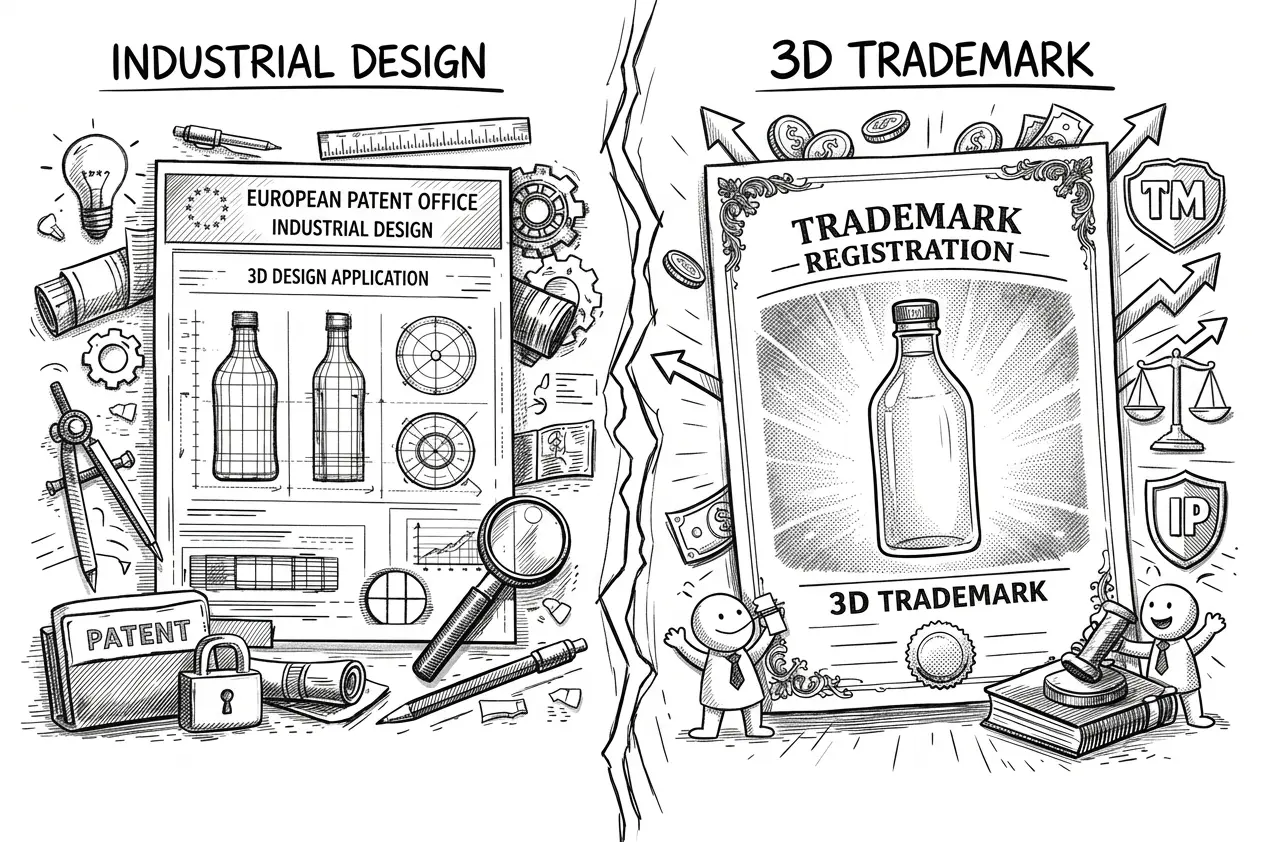
The Battle for Form: 3D Trademarks vs Industrial Designs
Introduction
In modern business, a product’s form has ceased to be merely an element of design—it has become a полноценный instrument of competition and branding. However, as the value of design increases, a key question arises: how can the shape of a product be properly protected?
This article examines where the boundary lies between an industrial design and a three-dimensional trademark in the EU, how case law is developing, and which strategy businesses should choose to protect product shape.
1. What is an industrial design?
1.1. An industrial design
Is an intellectual property object that protects the appearance of a product or its part, rather than its technical substance, determined by features such as lines, contours, color, shape, texture, and materials of the product or its ornamentation (Art. 3 of EU Regulation No. 6/2002).
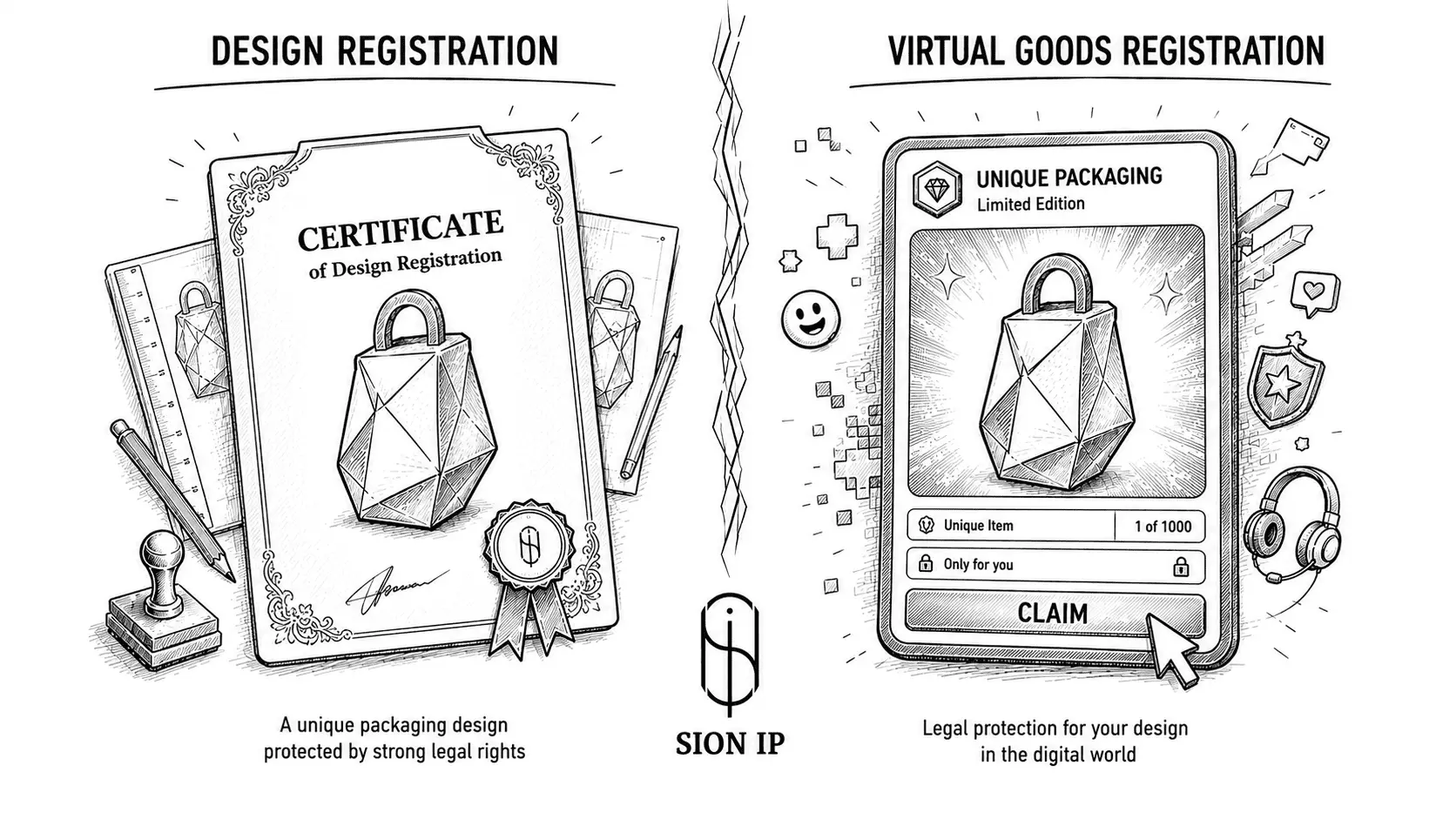
In practice, industrial designs are typically used at an early stage of product commercialization—when the shape has already been created but has not yet become a recognizable brand element. This is why, for new collections, packaging, seasonal solutions, and visually differentiated goods, this regime often serves as the first line of protection.
This mechanism is particularly востребован in industries where appearance itself has commercial value: packaging, perfumery, furniture, product design, fashion, décor, and event-related goods.
1.2. What can be registered as an industrial design?
Any design that meets two key criteria can be registered as an industrial design:
novelty — the design has not been disclosed to the public before
individual character — it creates a different overall impression on the informed user
These may include:
- the shape of a product (e.g., decorative elements of wedding design)
- packaging (boxes, bottles, gift solutions)
- the appearance of products (cakes, souvenirs, accessories)
- interior or decorative design elements
It is important to understand that protection applies to visual perception, not to the function of the product. If a shape is dictated exclusively by a technical function, it will not be protected as an industrial design. For businesses, it is critical to remember that protection is assessed not by the abstract “beauty” of a shape, but by whether the design creates a different overall impression on the informed user compared to existing solutions.
1.3. Examples of industrial designs
In practice, industrial designs are unique visual solutions that can be reproduced in a product. These may include:
- the shape of a bottle;
- a series of packaging;
- the shape of a lamp;
- a decorative furniture element;
- the appearance of jewelry;
- the original shape of a wedding cake;
- the appearance of a confectionery product, provided it is reproducible as product design.
The fashion and event design industries are particularly illustrative, where design is constantly updated and becomes a competitive advantage.
The more precisely the applicant presents the visual features of the object in the images filed, the clearer and stronger the scope of protection will be. In practice, the quality of visual materials often determines how easy it will be to enforce the right later.
1.4. Ways to obtain industrial design protection in Europe
If a business plans to protect product shape in Europe, it generally has three practical routes.
The first is national registration in a specific country. This option is suitable when protection is needed only in one or two jurisdictions. The application is filed directly with the national office, and the requirements and procedure are governed by local law. While this may be economically justified for targeted protection, it quickly becomes less convenient as the business expands geographically due to the need to manage multiple parallel procedures.
The second route is registration of a European Union design through EUIPO. This is the most convenient mechanism for companies operating in multiple EU markets or planning to scale. A single application, fee, and procedure provide protection across all 27 EU Member States. However, such protection does not extend to the United Kingdom, as EU rights no longer apply there automatically after Brexit.
The third route is international registration under the Hague System via WIPO. This option is particularly convenient when protection is required not only in the EU but also in multiple countries across different regions. The applicant files a single international application, designates the countries or organizations where protection is sought, and manages registration, renewal, and changes centrally. The Hague System does not fully replace national regimes but significantly simplifies international administration.
In practice, the choice depends not only on budget, but also on sales geography, time-to-market, and whether the company plans licensing or disputes in multiple jurisdictions.
1.5 Registered and unregistered industrial designs
Within the EU system, there are two forms of protection: registered and unregistered designs.
An unregistered design arises automatically upon the first public disclosure of the design within the EU and lasts for three years. This model is especially relevant in industries with short product life cycles—such as fashion, décor, packaging, or events. However, the scope of protection is narrower: the right holder can only prevent copying, while independent creation of a similar design by a third party is not considered infringement.
A registered EU design provides stronger protection. It grants an exclusive right to use the design and to prohibit use by third parties without consent. The protection lasts five years from the filing date, renewable in five-year increments up to a maximum of 25 years. For businesses planning long-term commercialization, this form is generally preferable.
For unregistered designs, documenting the date and circumstances of first disclosure is particularly important, as it may otherwise be difficult to prove when the right arose.
1.6. Criteria for protection and term
To qualify for protection, a design must meet the criteria of novelty and individual character. These requirements apply equally to both registered and unregistered designs.
Term of protection:
- registered design — up to 25 years (renewable every 5 years)
- unregistered design — 3 years from first public disclosure
This division allows businesses to flexibly choose their strategy: first test the design on the market, then decide whether to register it.
For businesses, this means that industrial design protection is especially effective where rights need to be secured quickly and a defined period of exclusivity is sufficient, without relying on perpetual protection.
1.7. Advantages and disadvantages
Industrial design is one of the most practical tools for protecting design, especially in fast-moving industries.
Advantages:
- Fast protection. Rights can be obtained quickly, and for unregistered designs arise automatically upon disclosure, enabling prompt protection when launching a product.
- Relatively predictable criteria. EU law clearly defines novelty and individual character, allowing businesses to assess prospects in advance and reduce legal uncertainty.
- Suitable for new products and packaging. Ideal when a product has not yet acquired brand recognition and cannot qualify for trademark protection.
- Compatibility with future trademark strategy. Often used as a first step before transitioning to a 3D trademark as the brand develops.
Disadvantages:
- Limited duration. Maximum protection is 25 years, after which the design enters the public domain.
- Vulnerability if novelty is lacking. Rights may be invalidated if prior similar designs are proven.
- Protection limited to visual aspects. Functional or technical features are not covered.
- Narrower protection for unregistered designs. Only copying is prohibited; independent creation remains lawful.
A typical mistake is disclosing a design too early and only later attempting registration after publication, exhibitions, or sales, when novelty becomes questionable.
2. 3D trademark: is long-term protection of shape possible?
2.1. What is a three-dimensional trademark?
A 3D trademark is the shape of a product, packaging, or another three-dimensional object used not merely as design but as a means of brand identification. EU law explicitly allows such signs to be registered, provided they can distinguish the goods of one undertaking from those of others.
The key difference from industrial design lies in purpose: design protection covers appearance as a creative result, whereas trademark protection covers shape as a branding tool. The same object may be assessed under both regimes: as design for appearance, and as a trademark if the shape is perceived as indicating commercial origin.
2.2. What can be registered as a 3D trademark?
The following may be registered:
- the shape of the product itself
- the shape of packaging
- a combination of shape and decorative elements
However, registrability is significantly restricted. EU law requires that the shape perform an identifying function, not merely be aesthetically appealing.
This means not every original shape can be registered. In practice, registrable shapes are those capable of indicating origin.
Typically not registrable:
- standard packaging;
- common industry shapes;
- shapes dictated by product function;
- shapes whose value lies mainly in aesthetics or function rather than branding.
2.3. Examples of 3D trademarks
Classic examples include:
- the contour Coca-Cola bottle
- the Toblerone chocolate shape
- distinctive perfume bottle designs
In these cases, the shape functions not only as appearance but also as a brand identifier. However, such cases are exceptions—most applications face objections based on lack of distinctiveness.
2.4. Conditions for registration
Registration of a 3D trademark in the EU is associated with stricter criteria compared to industrial design.
Distinctiveness
The shape must enable the consumer to clearly determine the commercial origin of the product. This means that it must significantly differ from ordinary shapes used in the industry.
Most product shapes initially lack distinctiveness and acquire it only through long-term use and active marketing.
Criteria:
- the shape must deviate from the industry norm;
- the consumer must perceive it as an indication of origin;
- in the absence of inherent distinctiveness, acquired distinctiveness must be proven.
Absence of functionality
According to EU law, shapes that:
- are exclusively dictated by the nature of the product
- are necessary to achieve a technical result
- give substantial value to the product
- are not eligible for registration (Art. 4 of EU Directive 2015/2436)
This criterion is fundamental. It is aimed at preventing a situation where a company obtains a monopoly over a technical or functional solution through trademark law.
What evidence is usually collected in cases of acquired distinctiveness:
- data on the duration of use of the shape;
- geography of sales;
- sales volumes;
- advertising materials;
- marketing studies;
- mentions in the media and by distributors;
- evidence that the shape is used specifically as an indication of origin.
2.5. Advantages and disadvantages
A three-dimensional trademark has a number of significant advantages but is also associated with high risks.
Advantages:
- Potentially perpetual protection with renewal. A 3D trademark can be protected indefinitely, provided that registration is renewed every 10 years.
- Protection not only against copies but also against similar signs. Legal protection extends to any shapes that are similar to the point of confusion, not only exact reproductions.
- Transformation of shape into a full-fledged brand asset. The product shape becomes an independent means of identification and enhances the market value of the brand.
Disadvantages:
- High threshold for registration. It is necessary to prove that the shape has distinctiveness and goes beyond standard solutions in the industry.
- Complex evidentiary base. The applicant must demonstrate that consumers perceive the shape as an indication of the commercial origin of the product.
- High risks of refusal due to functionality. A shape is not registrable if it is dictated by a technical function or necessary to achieve a certain result.
- Difficulty in proving that the shape has already become a sign of origin. In the absence of inherent distinctiveness, it is necessary to prove that it has been acquired through long-term and intensive use.
In practice, a 3D trademark usually makes sense not as a starting point, but as a secondary strategy — after the shape has already gained market recognition.
Key differences and conflict of regimes
Industrial design and 3D trademarks may apply to the same object but protect different interests. The former protects design as a creative result; the latter protects shape as a brand identifier.
The core difference lies in the nature of protection: design protects appearance, while a 3D trademark protects branding function.
This creates a “conflict of regimes”: businesses seek to extend protection from a time-limited design to a potentially perpetual trademark. EU law deliberately restricts this to prevent monopolization of shapes that should remain available for competition.
Comparative Table: Industrial Design vs. 3D Trademark
| Criterion | Industrial Design | 3D Trademark |
| Purpose | Protection of appearance | Protection of shape as a brand |
| Nature | Visual appearance | Means of identification |
| Object | Appearance of a product or part of a product | Shape indicating origin |
| Criteria | Novelty and individual character | Distinctiveness |
| Functionality | Must not solely determine appearance | Strictly prohibited |
| Right arises | From registration (or disclosure, for unregistered designs) | From registration (or acquired distinctiveness) |
| Term | Up to 25 years | Unlimited (renewable every 10 years) |
| Scope | Prohibits similar designs | Prohibits confusingly similar signs |
| Complexity | Relatively low | High |
| Risk of refusal | Medium | Very high |
| Evidence | Not required at filing in the EU | Often required |
| Typical use | New products, design | Established brands |
| Challenge risks | Lack of novelty | Functionality or lack of distinctiveness |
In practice, the choice depends on product stage: new designs are better protected as industrial designs, while recognized shapes may later qualify for trademark protection.
Why the EU restricts 3D trademarks
Businesses aim to use trademarks for “eternal protection,” but EU law and practice impose limits to avoid:
- monopolization of standard solutions
- restriction of competition
- barriers to market entry
Thus, strict filters apply: - functional shapes are excluded
- high distinctiveness threshold
- proof of consumer perception required
Most 3D shapes initially lack distinctiveness, making registration the exception rather than the rule.
4. Case law: where the boundary lies
EU case law shows that the boundary between design and a 3D trademark depends on the function of the shape in the consumer’s perception. If the shape is perceived as technically or typologically ordinary, registration of a trademark is difficult. If, however, it has become an independent identifier of the origin of the product, the chances increase.
It is precisely court cases that make it possible to understand where permissible protection ends and the risk of refusal begins.
4.1. The Ferrero case (candies, packaging)
Case number:
T-128/01 (Ferrero SpA v OHIM)
What was being registered:
Ferrero attempted to register the shape of chocolates (in particular, a spherical shape with a characteristic surface associated with Ferrero Rocher) as a three-dimensional trademark. The core strategy was to prove that consumers already perceived the shape of the product as a distinctive feature of the brand, rather than simply as the appearance of the product.
Applicant’s position:
The company argued that consumers already perceived the product shape as a brand element.
Grounds for refusal:
The Court held that the shape of the candy:
- is typical of the relevant category of goods
- does not possess sufficient distinctive character
- Even if a shape is recognizable, that is not enough — it must depart from market standards.
Conclusion for business:
Mere product popularity does not turn a shape into a trademark. The shape must objectively differ from typical solutions in the industry and be perceived as a brand, rather than as a variety of the product.
4.2. The LEGO case (bricks)
One of the most illustrative cases is the dispute over the registration of the shape of the LEGO brick as a trademark.
Case number:
C-48/09 P (Lego Juris A/S v OHIM)
What was being registered:
The shape of the classic LEGO brick.
Applicant’s position:
LEGO relied on the high recognizability of the shape and its association with the brand.
Grounds for refusal:
The Court of Justice of the EU confirmed that:
the shape is entirely dictated by a technical function — the ability to connect the elements to one another.
registration would lead to the monopolization of a technical solution
Even recognizability is irrelevant if the shape is functional.
Conclusion for business: A trademark must not be used for perpetual control over a technical solution, even where the brand is strong.
4.3. Coca-Cola case
In contrast to the LEGO case, the Coca-Cola case is an example of successful registration of a three-dimensional trademark.
Case number: A series of EUIPO decisions and EU case law (for example, T-305/02 — Coca-Cola Company v OHIM, and subsequent confirmations of registration)
What was being registered: The contour shape of the Coca-Cola bottle.
Applicant’s position: The bottle shape is unique and has long been associated with the brand.
Grounds for success: Registration became possible because:
- the shape is not dictated exclusively by a technical function
- it has a unique shape
- acquired distinctiveness was proven
The Court recognized that consumers identify the product by its shape without any logo.
Conclusion for business:
A shape can obtain protection as a trademark when it is not functionally necessary, clearly departs from the industry norm, and is supported by proof of long-term use as a brand identifier.
What case law shows
- technical shape — almost always a problem;
- an ordinary market shape — a weak candidate;
- a recognizable shape that has been promoted consistently — the best candidate for a 3D mark.
5. Strategies for Business
5.1. When to Choose an Industrial Design
5.1. When to choose an industrial design
An industrial design is usually chosen when the shape has already been created and is commercially significant, but has not yet acquired independent recognition as a brand.
It is especially relevant when:
- design is a key competitive advantage
- the product is only entering the market
- the product life cycle is limited (for example, seasonal collections, wedding trends, décor)
In addition, the EU system allows for the use of an unregistered industrial design, which makes it possible to obtain protection from the moment of first public disclosure without formalities.
This is especially relevant for packaging, new product lines, seasonal solutions, and designs with a short sales cycle, where the speed of securing rights matters more than a long-term trademark strategy.
5.2. When to Attempt to Register a 3D Trademark
Registration of a three-dimensional trademark is already the next stage, requiring brand maturity.
- It makes sense to try to register a 3D trademark when:
- the product shape has been used for a long time
- consumers are beginning to recognize the product specifically by its shape
- the design has become part of the brand identity
- there is evidence of recognition (marketing studies, sales volume, advertising)
In addition, it is necessary to assess the risks in advance:
- whether the shape is functional
- whether it is typical for the industry
- whether the application is likely to be refused
That is why registration of a 3D trademark is not a starting strategy, but an investment in long-term brand protection that requires time, systematic marketing, and the formation of a stable association in consumers’ minds between the shape and a specific producer.
5.3. Combined Protection
The most effective strategy, confirmed by EU practice and business experience, is a combined approach.
It involves the sequential use of two regimes:
Stage 1 — file for an industrial design
Stage 2 — launch the product on the market
Stage 3 — build recognition and accumulate evidence
Stage 4 — assess the prospects for a 3D trademark
This approach makes it possible to:
- immediately protect the appearance of the product
- test market demand
- over time turn the shape into a recognizable brand
- secure potentially perpetual protection
This approach makes it possible to work with, rather than against, the nature of the law: first the company protects the design as a new visual object, and then, if market recognition exists, attempts to turn the shape into a long-term brand asset.

5.4. Common Mistakes by Companies
Practice shows that businesses often make the same mistakes when protecting product shape.
The first common mistake is trying to register a 3D trademark right away without proven recognition. This almost always leads to refusal.
The second mistake is ignoring the functionality of the shape. If the shape is dictated by a technical purpose, it will not be protected as a trademark regardless of marketing efforts.
The third mistake is underestimating the industrial design route. Many companies skip this stage, losing the opportunity for quick and effective protection at the outset.
The fourth mistake is the absence of a strategy. Rights are registered in a fragmented way, without an understanding of the long-term objective, which reduces the effectiveness of protection.
Finally, an important problem is insufficient work on the evidentiary basis. Without proof that the shape is perceived as a brand, even a strong design will not obtain protection as a trademark.
Conclusion
For businesses, the key takeaway is that industrial design and a 3D trademark solve different problems and most often should be used sequentially.
An industrial design is a tool for quickly securing rights in a new design.
A 3D trademark is a later and more complex strategy, possible only when the shape has already come to be perceived by the market as a brand element.
Therefore, effective shape protection begins not with an attempt to obtain an “eternal monopoly,” but with a properly structured step-by-step IP strategy.
Before choosing a protection regime, a company should assess three things: the stage of the product life cycle, the existence of novelty, and the prospects of proving the distinctiveness of the shape. It is this preliminary assessment that usually determines whether a shape protection strategy will be viable in the long term.
This material is for informational purposes only and does not replace an individual legal assessment, since the protectability of a shape always depends on the specific object, the market, evidence of use, and the chosen jurisdiction.
Sources
EU Regulation No. 6/2002 on industrial designs (https://eur-lex.europa.eu/legal-content/EN/TXT/?uri=CELEX:32002R0006)
— the main document regulating the protection of industrial designs in the EU.
EU Directive 2015/2436 on trademarks of the European Union (https://www.wipo.int/wipolex/ru/legislation/details/18298) — regulates trademarks in the EU, including 3D trademarks.
Article on zakon.ru: “3D trademarks — quadratisch, praktisch, gut” (https://zakon.ru/blog/2020/05/04/3d_tovarnye_znaki_quadratisch_praktisch_gut_83655) — overview and features of 3D trademarks.
Documents from EU case law, including decisions in the Ferrero, LEGO, and Coca-Cola cases.
Article “Specifics of legal protection of three-dimensional objects” (https://cyberleninka.ru/article/n/spetsifika-pravovoy-ohrany-trehmernyh-obektov ) — research on the legal protection of three-dimensional objects, including 3D trademarks and industrial designs.
Article: “Strategies for legal protection of three-dimensional design: choosing between a trademark and an industrial design” — author: Bogdanets A.S. (https://cyberleninka.ru/article/n/strategii-pravovoy-ohrany-trehmernogo-dizayna-vybor-mezhdu-tovarnym-znakom-i-promyshlennym-obraztsom) — analysis of legal protection of three-dimensional objects and discussion of criteria for choosing between a trademark and an industrial design.
 08/07/2026
 07/07/2026
 08/06/2026
 05/06/2026