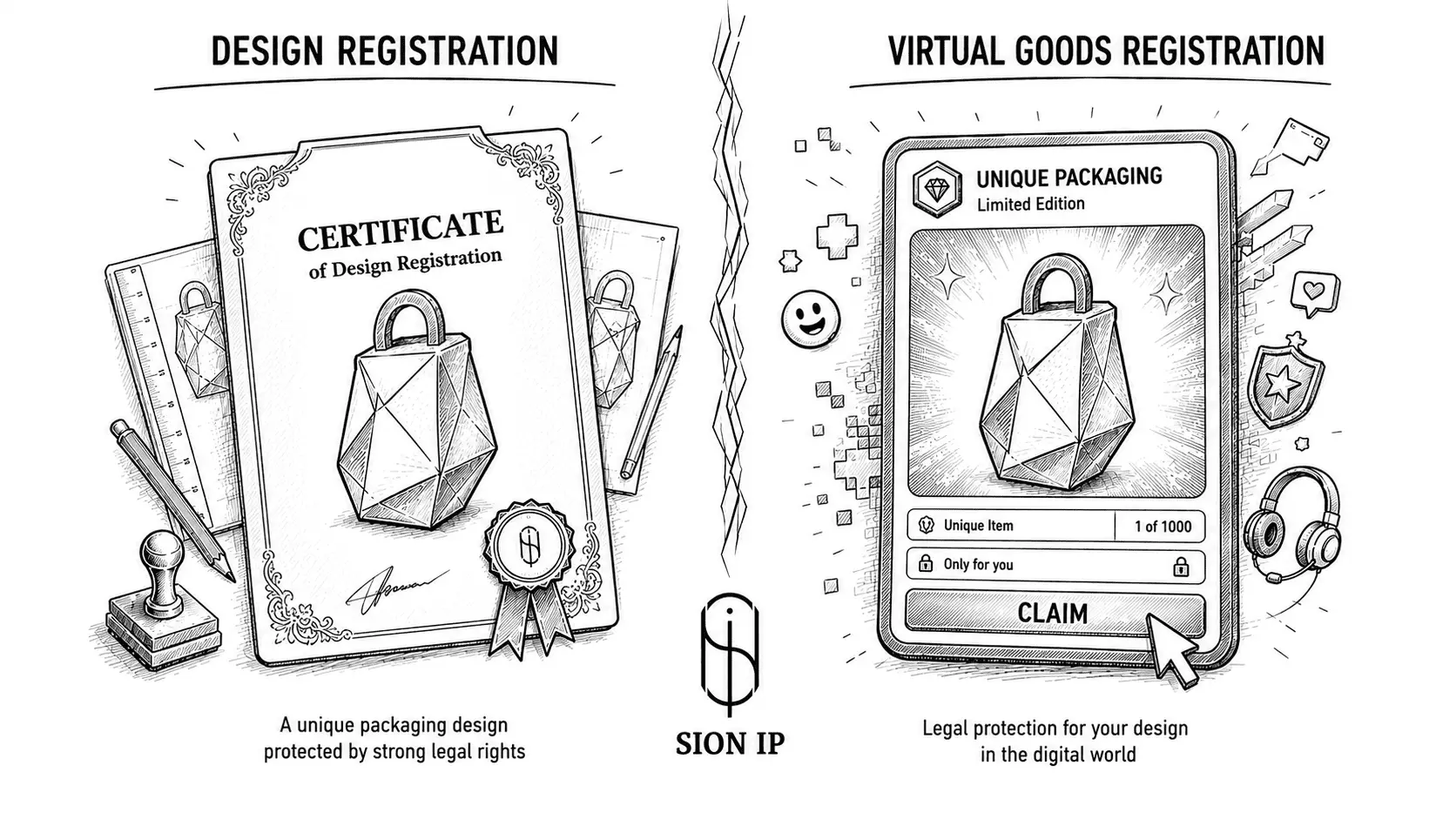
How to Protect Packaging Design in the Digital Age
Natalia Riazanova
Introduction
Product packaging no longer exists only on a retail shelf. The same package may appear in an Amazon listing, on a brand website, in advertising creatives, in social media content, in 3D product renderings, in augmented reality previews and, increasingly, as part of digital product presentations or virtual goods strategies.
This changes the legal and commercial role of packaging. Packaging is no longer merely a container. For many consumer brands, it is a valuable commercial asset that influences first impressions, click-through rates, conversion, consumer recognition and perceived product positioning.
It also makes packaging easier to copy. A competitor no longer needs to replicate a full retail supply chain before imitating a successful product appearance. In many cases, it may be enough to copy product images, imitate label layout, adapt colour schemes, reproduce a similar package shape and upload a competing marketplace listing.
For brand owners, e-commerce businesses, Amazon sellers, FMCG companies, cosmetics brands, supplement companies and legal or marketing teams, the practical question is clear: how can a company protect packaging design when the same visual asset exists across physical products, digital listings, 3D visuals and virtual product environments?
The answer is rarely a single registration. Effective packaging design protection usually requires a coordinated IP strategy combining industrial design protection, trademark protection for packaging, trade dress assessment, copyright ownership, marketplace monitoring, evidence collection and, where commercially relevant, protection for digital product designs, 3D assets and virtual goods.
This article provides a practical overview. It does not assume that the same rules apply in every jurisdiction. Design, trademark, trade dress and copyright protection differ significantly between the EU, UK, US and other markets.
Why Packaging Design Is Easier to Copy Online
Marketplaces have changed the speed and economics of copying.
In a traditional retail environment, copying successful packaging usually required several steps: manufacturing, distribution, access to retail channels, physical shelf placement and time. Today, much of the competition begins at the level of digital content. Sellers compete through thumbnails, product images, search results, comparison pages, sponsored listings and algorithmic recommendations.
Competitors may imitate:
- packaging shape;
- bottle, jar, tube or container geometry;
- product listing visuals;
- colour palette;
- label hierarchy;
- typography style;
- product presentation angle;
- image composition;
- surface decoration;
- ornamental layout;
- 3D product renders;
- online product visuals.
This happens because consumers often make decisions visually and quickly, especially on marketplaces. A package that performs well online becomes a visible commercial signal. Competitors may then attempt to reproduce not the exact brand name, but the overall visual impression that made the original product successful.
Practical Scenario
A cosmetics brand launches a minimalist skincare line. The packaging uses a distinctive bottle silhouette, soft neutral colours, a particular label layout and clean product photography. The line performs well on Amazon and gains visibility, reviews and ranking.
Within weeks, similar products appear with:
- comparable bottle geometry;
- similar colour combinations;
- nearly identical visual hierarchy;
- similar product photography style;
- alternative names and logos.
The competitor may avoid copying the trademark directly. However, consumers may still perceive the products as related, affiliated, interchangeable or coming from the same commercial source.
The business consequences can be significant:
- visual identity becomes diluted;
- brand distinctiveness weakens;
- consumers may confuse products;
- competition shifts from brand value to price;
- the original brand loses part of its marketplace advantage;
- enforcement becomes harder if no rights were secured before launch.
This is why a lack of protection is not an abstract IP issue. For packaging-heavy brands, it can become a direct loss of market position.
Packaging as an Industrial Design, Registered Design or Design Patent
Packaging may often be protected through design law, but terminology differs by jurisdiction.
In international IP language, the term industrial design is commonly used. WIPO explains that an industrial design concerns the ornamental or aesthetic aspect of an article and may consist of three-dimensional features, such as shape, or two-dimensional features, such as patterns, lines or colour. Industrial design protection is generally concerned with appearance rather than technical function.
In the UK, the term registered design remains commonly used.
In the EU, following the EU design reform, the former Registered Community Design terminology has been replaced by Registered European Union Design. The former Unregistered Community Design terminology has been replaced by Unregistered European Union Design. EUIPO materials on the design reform identify these terminology changes, and the 2025 EUIPO Designs Reform Guidelines refer to the updated terminology, including the change from RCD to REUD.
In the United States, the comparable form of protection is a design patent, which protects a new, original and ornamental design for an article of manufacture. The scope, requirements and filing practice differ from EU and UK registered design systems.
For packaging, design protection may cover, depending on the jurisdiction and filing strategy:
- shape of the package;
- configuration;
- contours;
- lines;
- external appearance;
- surface decoration;
- ornamentation;
- label layout, where eligible;
- visual composition;
- packaging graphics, where they form part of the protected design.
EUIPO describes design protection as covering the appearance of the whole or part of a product resulting from features such as lines, contours, colours, shape, texture, materials and ornamentation.
The key point is that a design right protects the visual appearance of the product or packaging. It does not protect the brand name itself. Brand names, logos and slogans are usually addressed through trademark protection.
Example
If a competitor uses a different logo, different brand name and different wording, but reproduces a similar overall appearance of the packaging, the right holder may still have grounds to act based on design rights, subject to the relevant jurisdiction, scope of protection and infringement test.
This makes industrial design protection particularly important in e-commerce, where copycats often avoid direct trademark copying but imitate the visual look that attracts consumers.
EU Design Reform 2024–2026: Why It Matters for Packaging and Digital Assets
The EU design system has recently been modernised through Regulation (EU) 2024/2822 and Directive (EU) 2024/2823. The reform updates the EU design framework, including terminology, definitions and procedural aspects. EUIPO’s Design Reform Hub explains the implementation of the reform, and the 2025 EUIPO Guidelines were updated to reflect reform-related changes.
For packaging and digital product presentation, the reform is relevant because it modernises the design protection framework and reflects the commercial importance of digital designs, dynamic features, 3D assets, virtual environments and non-physical product appearances.
However, the reform should not be overstated. It does not mean that every digital product, virtual good or online rendering is automatically protectable. Eligibility, filing requirements, classification, representation rules and enforcement strategy must still be assessed case by case.
For businesses, the practical point is this: if packaging is used not only physically but also in 3D renders, online product visuals, virtual environments or digital goods, the design protection strategy should be reviewed under the current EU rules at the time of filing.
The reform is being implemented in phases, and national implementation under the Directive may affect local design systems. Companies planning EU protection should therefore check the applicable rules, EUIPO practice and national implementation status before filing.
What Packaging Design Protection Does Not Cover
Not every packaging element is protectable.
In many jurisdictions, design protection usually does not extend to:
- features dictated solely by technical function;
- standard or common packaging shapes;
- generic containers;
- purely functional design solutions;
- design features that do not meet the applicable novelty or individual character requirements;
- visual elements that are not properly represented or claimed in the filing.
For design protection, the key issues often include novelty, individual character, ornamentality and the exclusion of features dictated solely by technical function. For trademark or trade dress protection, the key issues include distinctiveness, source identification and non-functionality.
Those are different legal tests. They should not be merged.
For example, a basic cylindrical bottle is unlikely to be protectable by itself if it has no distinctive design features. However, a particular combination of proportions, contours, decorative elements, surface layout, colour blocking and ornamental features may support a stronger protection strategy.
This distinction matters at both filing and enforcement stages. A registration that claims only generic or functional features may be weak. Conversely, a carefully prepared filing that captures distinctive visual elements may provide a stronger basis for action.
Small Changes Do Not Always Avoid Infringement
Competitors sometimes assume that minor modifications are enough to avoid liability. That assumption can be dangerous.
In many design infringement assessments, the issue is not whether every detail is identical, but whether the allegedly infringing design creates a similar overall visual impression. The precise legal test differs by jurisdiction.
The practical conclusion is simple: the scope of protection should be assessed before filing and again before enforcement. A design registration is only as useful as the visual features it actually protects.
Why Registration Alone Is Not Enough
Many companies assume that once they register a design or trademark, protection becomes automatic. In practice, it does not.
Marketplaces do not generally monitor infringements on behalf of every rights holder. Infringing listings may remain online until the rights holder acts. Platforms typically respond to formal complaints based on specific IP rights, evidence and platform procedures.
Effective protection usually requires:
- regular marketplace monitoring;
- identification of similar listings;
- evidence collection;
- dated screenshots and URLs;
- comparison of designs;
- filing complaints through platform tools;
- follow-up communication;
- escalation where necessary;
- internal ownership documentation.
Timing is critical. In digital markets, an infringing listing can generate sales, reviews and ranking before the original brand even becomes aware of it. If the copy remains online for months, the commercial damage may already be done.
Even with registration, several questions may arise:
- Which right is being infringed?
- Does the registration cover the relevant jurisdiction?
- Does the registration cover the copied features?
- Is the similarity sufficient under the applicable test?
- Does the platform accept this type of claim?
- Is the complaint supported by adequate evidence?
- Is the asserted right correctly matched to the alleged infringement?
This is why product packaging IP strategy should not be treated as a one-off administrative filing. It is an ongoing risk management and enforcement process.
How to Protect Packaging Design on Marketplaces
Marketplace protection works best when legal rights, platform tools and monitoring are combined.
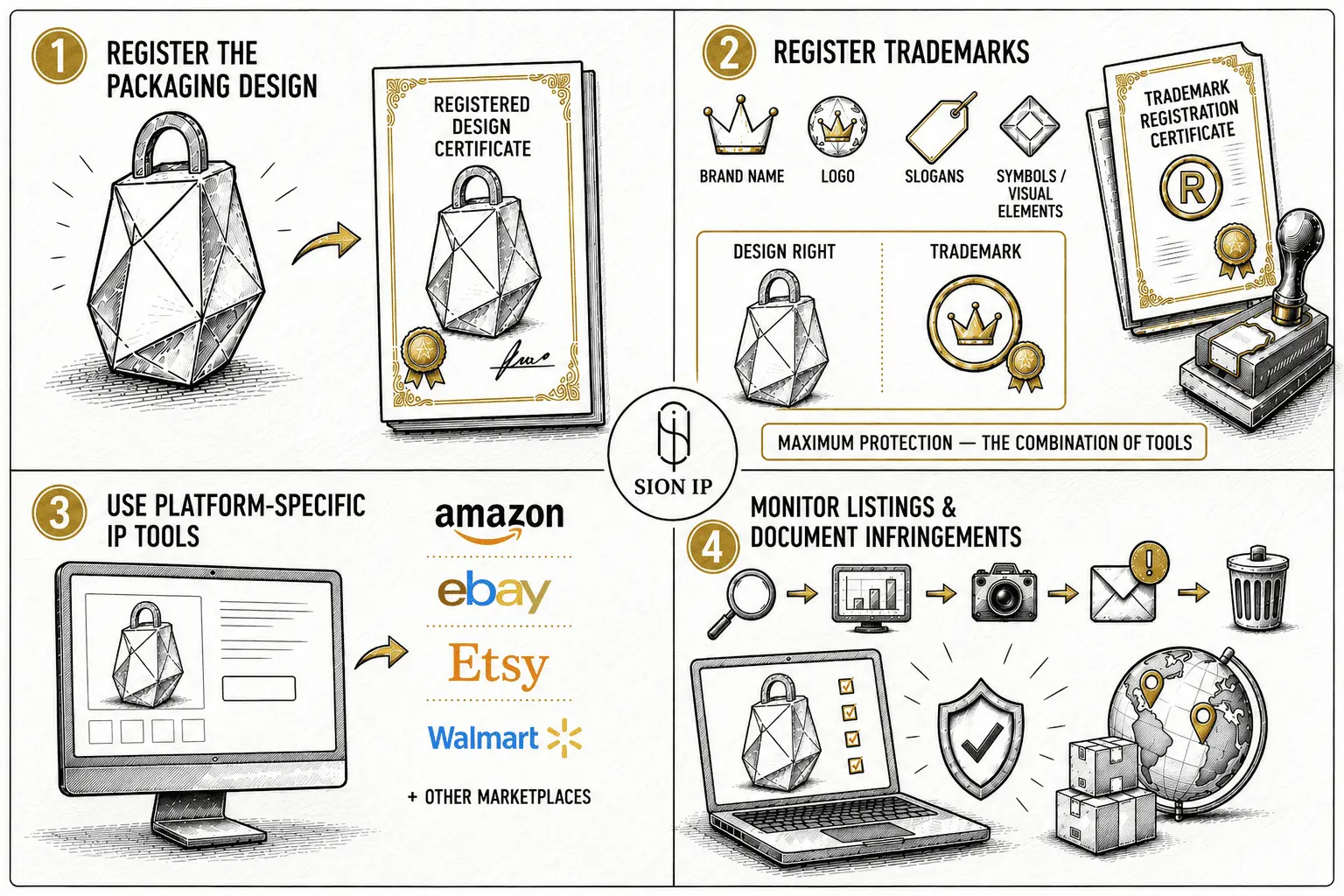
1. Register the Packaging Design
Registered design packaging protection gives the company a legal basis to act against copied packaging appearance. It is especially important when:
- the competitor uses a different logo;
- the brand name is not copied;
- the copying concerns shape, configuration or visual appearance;
- the product is sold in the same category;
- the marketplace listing creates a similar overall impression;
- the brand intends to scale internationally.
Because IP rights are territorial, registration should be planned around the markets where the product is manufactured, sold and likely to be copied. A registration in one country does not automatically provide worldwide protection.
For brands preparing to scale internationally, design filing should normally be considered before major public launches, not after copies appear.
2. Register Trademarks
Trademarks protect brand identifiers, such as:
- brand name;
- logo;
- slogans;
- distinctive symbols;
- in some cases, non-traditional signs such as colours, shapes or packaging elements, depending on jurisdiction and distinctiveness.
A design right protects the appearance of the product or packaging. A trademark protects signs that identify commercial origin. Combining both usually gives stronger protection than relying on one right alone.
This is particularly important where the competitor copies the brand name, uses a confusingly similar logo or creates a listing that suggests affiliation with the original brand.
3. Use Platform-Specific IP Tools
Brands selling online should also use platform-specific IP tools, including:
- Amazon Brand Registry;
- Amazon Report Infringement tools;
- eBay VeRO Program;
- Etsy Reporting Portal;
- Walmart Brand Portal or IP Claim Form;
- other marketplace brand protection systems.
Amazon’s Report Infringement form is intended for intellectual property rights owners and their agents to notify Amazon of alleged IP infringements. eBay’s policy refers to IP rights including copyrights, trademarks, designs, patents and utility models. Etsy provides a reporting portal for IP complaints, and Walmart states that incomplete or inaccurate submissions may prevent processing of an IP claim.
Platform enforcement tools can be valuable, but they are not a substitute for registered rights or a structured IP strategy. A platform may reject a complaint if the asserted right does not match the alleged infringement, if the evidence is insufficient or if the comparison is unclear.
For example, an Amazon Brand Registry infringement complaint based on a word trademark may not be the right tool where the actual issue is copied packaging shape or visual layout. In that situation, a design right, copyright claim or trade dress argument may be more relevant, depending on the facts and jurisdiction.
4. Monitor Listings and Document Infringements
Monitoring is a continuous process. Brands should track:
- identical copies;
- confusingly similar packaging;
- similar product photography;
- suspicious listings;
- copycat sellers;
- duplicate product pages;
- unauthorized use of images;
- copied 3D renderings or product visuals.
Evidence should include:
- screenshots;
- listing URLs;
- seller information;
- dates;
- product comparisons;
- copies of registration certificates;
- proof of ownership or authorization;
- purchase records where test buys are appropriate;
- documentation showing original creation and launch dates.
Without monitoring, even a strong IP portfolio remains underused.
Design Rights, Trademarks and Trade Dress: Key Differences
For an international English-speaking business audience, it is essential to distinguish design rights, trademarks and trade dress.
| Protection Tool | What It Usually Protects | When It Is Useful |
| Industrial design / registered design / REUD | Shape, configuration, visual appearance, ornamentation | When packaging appearance is copied |
| Design patent | New, original and ornamental design for an article of manufacture in the US | When the ornamental design of a product or package is copied in the US market |
| Trademark | Name, logo, slogan or other sign identifying commercial origin | When brand identity or source indicators are copied |
| Trade dress | Overall commercial impression that identifies source, especially under US law | When packaging or product presentation functions as a source identifier |
| Copyright | Original artwork, graphics, photographs, renders or other creative works, where eligible | When original creative assets are copied |
| Marketplace tools | Procedural enforcement channels based on existing IP rights | When infringement occurs on Amazon, eBay, Etsy, Walmart or similar platforms |
Design Rights / Industrial Designs
Design rights protect the appearance of a product or packaging. They are useful where the visual form, configuration or ornamentation is copied, even if the brand name is different.
For design protection, the key issues often include:
- novelty;
- individual character;
- ornamentality;
- visual impression;
- correct representation;
- exclusion of features dictated solely by technical function.
Trademarks
Trademarks protect signs that distinguish the goods or services of one business from those of others. They are essential for names, logos, slogans and other source identifiers.
For trademark protection, the key issues usually include:
- distinctiveness;
- source identification;
- likelihood of confusion;
- proper classification of goods and services;
- use requirements in jurisdictions that require use;
- registrability of non-traditional signs, where relevant.
Trade Dress
Trade dress may protect the overall look and feel of a product or packaging if it identifies commercial origin and is non-functional. This concept is particularly important under US law.
Trade dress elements may include:
- packaging shape;
- packaging layout;
- colour combinations;
- product configuration;
- visual presentation;
- store design;
- product display format.
Under US law, product packaging trade dress may in some cases be inherently distinctive, while product design trade dress generally requires proof of acquired distinctiveness or secondary meaning. In close cases, the claimed trade dress may be treated as product design rather than packaging, which makes evidence of secondary meaning especially important. The US Supreme Court’s decision in Wal-Mart Stores, Inc. v. Samara Brothers, Inc. is central to this distinction.
Functionality remains a key limitation. Even visually distinctive packaging or product presentation may not be protectable as trade dress if the claimed features are functional.
The practical conclusion is that a company should not rely on one form of protection only. The most effective strategy often combines:
- design registration;
- trademark registration;
- trade dress arguments where available;
- copyright claims where relevant;
- unfair competition claims where available;
- marketplace enforcement tools.
Digital Product Designs, 3D Models and Virtual Goods
Design now exists not only as a physical object, but also as a digital asset.
Brands increasingly use:
- 3D models;
- digital product representations;
- digital product renderings;
- augmented reality previews;
- marketplace visuals;
- interactive product images;
- virtual goods;
- downloadable virtual goods;
- non-downloadable virtual goods;
- digital collectibles;
- branded assets for games or virtual worlds;
- virtual product environments.
This should not be treated only as a speculative “metaverse” issue. It is already relevant to ordinary e-commerce.
Consumers often interact with the image of the product before they interact with the physical product. The digital representation itself becomes commercially valuable.
Practical Risk
A company creates a unique 3D rendering of its packaging for marketplace listings. A competitor uses a very similar rendering, copies the same visual angle, imitates the lighting and adapts the same product presentation style.
Even before purchase, consumers may associate the competitor’s product with the original brand. The harm occurs at the level of attention, recognition and conversion.
The business consequences may include:
- loss of visual uniqueness;
- consumer confusion;
- dilution of brand identity;
- unauthorized use of digital assets;
- weaker control over product presentation;
- difficulty distinguishing original listings from copycat listings.
This is why digital product design protection and 3D product design protection should be reviewed as part of broader brand protection planning.
In the US, practice concerning digital and computer-generated designs is developing. The USPTO’s 2026 supplemental guidance addresses examination of design patent applications related to computer-generated interfaces and icons and refers to issues under 35 U.S.C. §171. This does not mean that any virtual product or digital rendering is automatically eligible for design patent protection. Eligibility should be assessed under current USPTO guidance and filing practice.
When Should Brands Consider Protection for Virtual Goods and 3D Assets?
Brands should consider separate protection for virtual goods, digital designs and 3D assets where those assets have independent commercial value or enforcement relevance.
Separate filings or documentation may be relevant if the brand:
- sells downloadable virtual goods;
- provides non-downloadable virtual goods or related services;
- uses branded digital goods in online environments;
- sells NFTs or digital collectibles;
- creates branded assets for games, virtual worlds or AR environments;
- relies heavily on 3D product renders or digital product presentation;
- licenses digital product assets to third parties;
- plans virtual goods trademark filings;
- operates internationally;
- expects copycats to imitate digital product presentation.
In some cases, companies may consider trademark filings that cover downloadable virtual goods, digital goods, online retail services involving virtual goods, entertainment services in virtual environments or related services, depending on the jurisdiction and business model.
However, terminology matters. Terms such as “virtual goods” may be insufficient on their own in trademark specifications. The type of virtual goods or services should be identified with sufficient precision according to the applicable trademark office’s practice. EUIPO guidance treats virtual goods as non-physical items intended for use in trade in online or virtual environments and applies ordinary classification principles to virtual goods and services in virtual environments.
USPTO materials on newer technologies similarly emphasise that identifications involving NFTs and virtual goods should specify the nature of the goods or services with sufficient clarity.
Separate virtual goods protection may be less urgent if:
- the brand has no digital product presence;
- digital visuals are not commercially important;
- the company does not use 3D models or interactive content;
- the product is sold only in limited offline channels;
- there is no realistic risk of online scaling or copying.
Even where virtual goods trademark protection is not immediately necessary, digital risks should still be reviewed. A brand may not need a virtual goods trademark filing today, but it may still need:
- copyright documentation for renderings;
- clear contracts with designers and 3D artists;
- ownership of source files;
- licensing terms for digital assets;
- evidence procedures for marketplace enforcement;
- internal rules on use of product images and renders.
Before launching a new product line online, brands should review which visual assets require protection and in which jurisdictions registration is commercially justified.
Risks of Leaving Packaging Design Unprotected
Leaving packaging design unprotected can create legal, commercial and strategic risks.
A company may face:
- copied packaging on marketplaces;
- loss of visual distinctiveness;
- weaker brand recognition;
- unauthorized use of product images;
- price-based competition;
- consumer confusion;
- imitation by third-party sellers;
- difficulty removing infringing listings;
- loss of international expansion opportunities;
- digital copying of 3D models or renderings;
- reduced value of the brand as an asset.
The most serious risk is loss of control over visual identity. Once the market becomes filled with similar packaging, rebuilding distinctiveness can be expensive and slow.
This is especially damaging for FMCG, cosmetics, beauty, supplements, consumer electronics accessories, home goods and other categories where visual presentation strongly influences purchasing decisions.
Building an IP Strategy for Packaging Design
An effective product packaging IP strategy should include several layers.
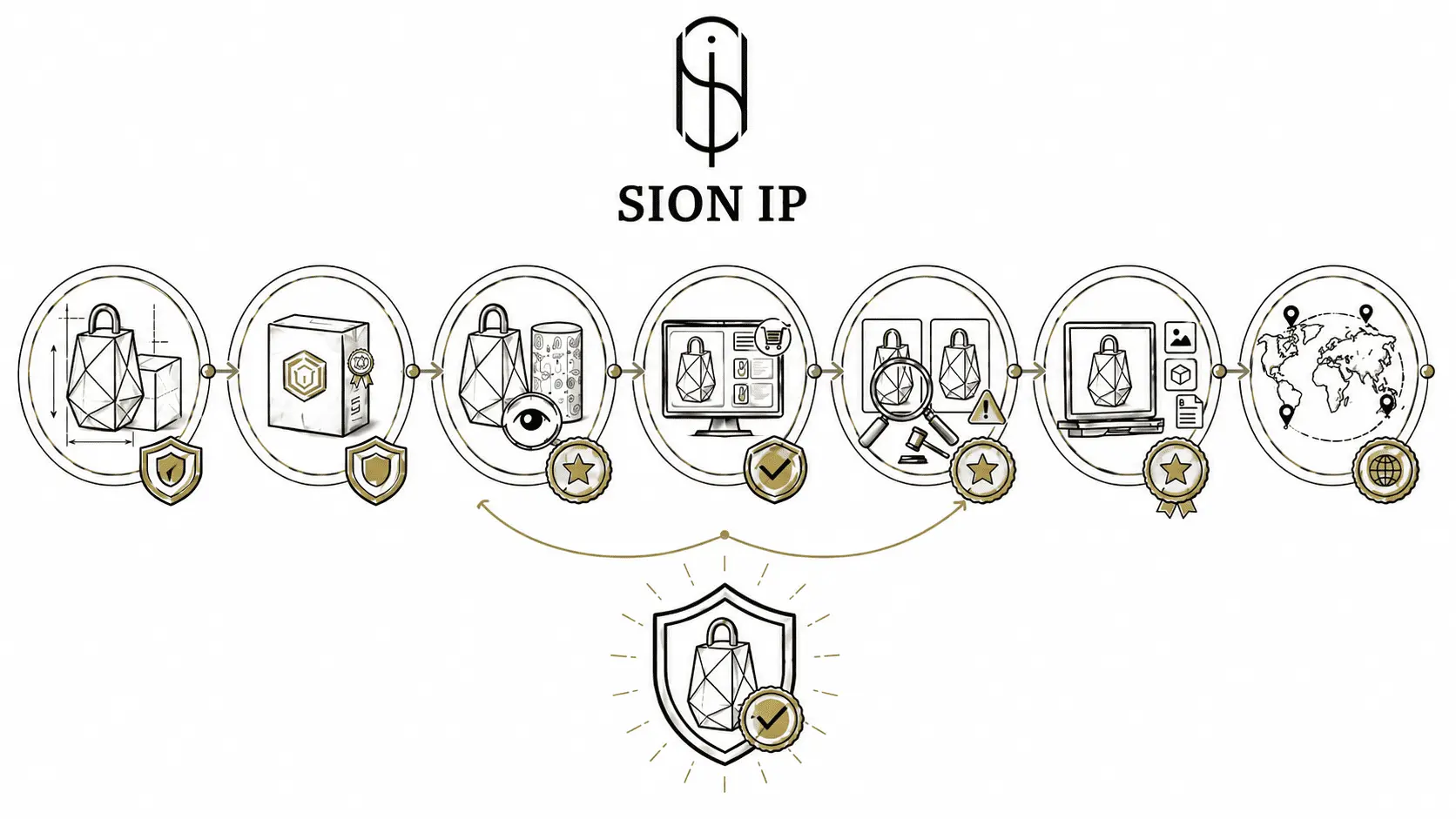
1. Design Registration
Design registration protects packaging shape, configuration and visual appearance. It is particularly useful where the commercial value lies in the look of the package, not only in the brand name.
In the EU, companies should use the updated design terminology and assess whether a Registered European Union Design is appropriate. In the UK, registered design protection remains a common route. In the US, design patent packaging protection may be relevant where the packaging includes a new, original and ornamental design for an article of manufacture.
2. Trademark Registration
Trademark registration protects the name, logo and other brand identifiers. It is essential for marketplace enforcement and long-term brand ownership.
Trademark filings should reflect actual and planned use, including international expansion and any digital goods or virtual services that are commercially relevant.
3. Trade Dress Assessment
Packaging trade dress may be relevant in markets such as the United States, where the overall look and feel of packaging may function as a source identifier.
This should be assessed carefully because distinctiveness, non-functionality and evidence of consumer recognition may be central issues. Product packaging and product design are treated differently under US trade dress law, and borderline cases require particular care.
4. Copyright and Digital Asset Ownership
Copyright may assist where original artwork, product photographs, 3D renders, illustrations or advertising visuals are copied.
However, copyright ownership should not be assumed. Companies should confirm that contracts with employees, agencies, freelancers, photographers, designers and 3D artists properly assign or license the relevant rights.
This is especially important where product visuals are used in marketplace listings, advertising campaigns, packaging files, AR previews or digital product environments.
5. Marketplace Protection
Marketplace protection includes Amazon Brand Registry infringement tools and similar platform channels. These tools are not substitutes for IP rights, but they can make enforcement faster and more structured.
Platform enforcement is procedural and may vary depending on the marketplace. Rights must be monitored, documented and enforced.
6. Monitoring and Enforcement
Monitoring should include regular searches, evidence collection, comparison of listings and complaint filing. For fast-moving categories, this may need to be a recurring process rather than an occasional check.
The enforcement file should include:
- registrations;
- ownership documents;
- original design files;
- creation dates;
- launch records;
- screenshots;
- URLs;
- product comparison charts;
- correspondence with platforms;
- outcomes of previous complaints.
7. Digital Asset Review
Digital asset review should cover:
- 3D models;
- product renderings;
- product photography;
- virtual product versions;
- online visuals;
- downloadable virtual goods;
- non-downloadable virtual goods;
- source files;
- agency contracts;
- freelancer assignments;
- licensing terms;
- marketplace evidence procedures.
8. International Filing Strategy
IP rights are territorial. A company should consider protection in:
- countries of manufacture;
- countries of sale;
- major marketplace jurisdictions;
- regions where copying is likely;
- markets planned for future expansion.
For example, a brand manufacturing in one jurisdiction, selling in the EU and US, and using Amazon internationally may need a different filing strategy from a brand selling only through local offline distributors.
If packaging design is a key part of the product’s market positioning, it is worth assessing whether design registration, trademark protection, copyright ownership, trade dress arguments and marketplace enforcement tools should be combined into a single IP strategy.
Common Mistakes Companies Make
Mistake 1: Filing Too Late
Many companies start registration only after copies appear. By then, competitors may already have listings, sales history, reviews and marketplace ranking.
Public disclosure before filing may destroy novelty in many jurisdictions. Some jurisdictions provide grace periods, but they differ significantly and should not be relied on as a global filing strategy.
For packaging intended for international launch, design filing should normally be considered before public disclosure, marketplace launch, trade show presentation or social media campaign.
This is particularly important for e-commerce brands and Amazon sellers because product images can become publicly visible very quickly and may be indexed, copied or archived before the company has finalised its IP position.
Mistake 2: Relying Only on the Brand Name
A word trademark does not automatically protect packaging appearance. If visual design is commercially important, it should be protected separately.
This is especially relevant where copycats use different names but imitate the look of the product.
Mistake 3: Ignoring Marketplaces
Marketplaces are not just sales channels. They are high-risk environments for IP infringement because copying can be fast, visible and commercially effective.
A brand protection plan that ignores Amazon, eBay, Etsy, Walmart Marketplace, Allegro and similar platforms is incomplete.
Mistake 4: Assuming Platforms Will Act Automatically
Platforms usually require a rights holder complaint and supporting evidence. Passive ownership of IP rights is rarely enough.
A company should know which rights it owns, where they are registered and how to present them in platform complaints.
Mistake 5: Ignoring Digital Product Assets
Brands often protect the physical product but overlook 3D models, renderings, product images and virtual presentations.
This can create enforcement gaps, especially where the copied asset is not the physical product itself but the digital representation used to sell it.
Mistake 6: No International Strategy
A registration in one country does not automatically protect the design worldwide. International expansion should be matched with international IP planning.
This is particularly important for e-commerce businesses because products can become visible in multiple markets before the company has built a matching IP portfolio.
Mistake 7: Unclear Designer and Agency Contracts
A company may assume that it owns packaging artwork, product photography, 3D renders or source files simply because it paid for them. That assumption can be wrong depending on the contract and jurisdiction.
Ownership, assignment, licensing, source files, editable files and enforcement rights should be addressed expressly before launch.
Practical Checklist Before Launching New Packaging Online
Before launching new packaging online, brands should ask:
- Has the packaging design been assessed before public disclosure?
- Are the key markets for design filing identified?
- Are the shape, label layout, surface ornamentation and visual composition protectable?
- Are the brand name, logo and slogans covered by trademark filings?
- Are product photographs, 3D renders and source files owned by the company?
- Are contracts with designers, agencies, photographers and freelancers clear on IP ownership?
- Are Amazon Brand Registry or other marketplace tools prepared?
- Is there an evidence collection and enforcement process?
- Are digital goods, virtual products or 3D assets commercially relevant?
- Is there an international filing strategy?
- Has the company reviewed novelty risks before trade shows, social media campaigns or marketplace publication?
- Are internal teams aligned on what can be disclosed before filing?
- Are enforcement responsibilities assigned internally or to external counsel?
This checklist is not a substitute for legal review, but it helps companies identify common gaps before a public launch.
FAQ: Packaging Design Protection
1. Can packaging design be protected separately from the brand name?
In many jurisdictions, yes. A trademark can protect the brand name or logo. A design right, registered design, or design patent can protect how the packaging looks. Trade dress may matter too, when the overall packaging shows where the product comes from.
2. Is Amazon Brand Registry enough to protect packaging?
No. Brand Registry and similar tools are enforcement channels, not IP rights. They work best with registered trademarks, design rights, copyright evidence, or other enforceable rights behind them.
3. Can I protect a 3D render of my product packaging?
Maybe. It depends on the asset and the jurisdiction. Copyright can protect original renders where eligible. Design protection may cover the look of the product or packaging. Ownership of the source and render files, set out in a contract, matters a lot.
4. Do I need separate trademark filings for virtual goods?
Not always. If you sell or plan to sell digital goods, NFTs, digital collectibles, branded game assets, or other virtual goods, separate protection may be needed. Name the type of virtual goods or services clearly in the filing.
5. Does one registered design protect packaging worldwide?
No. IP rights are territorial. A registration in one country or region doesn’t protect the design everywhere. Plan your filings around where you make, sell, and enforce, and where you plan to expand.
6. Should I file the packaging design before launch?
In many cases, yes. Showing the design publicly before filing can destroy novelty in many countries. Some countries have grace periods, but they differ, so don’t rely on them as a global strategy.
Conclusion
Packaging design is now both a physical and digital asset. It appears on shelves, marketplaces, product listings, advertisements, social media, 3D visuals, augmented reality previews and virtual environments.
Marketplaces have made copying faster and easier. A competitor may imitate the appearance of successful packaging without copying the brand name directly. That can still damage visual identity, consumer recognition and marketplace position.
Industrial design protection, registered design protection and, in the United States, design patents can protect the visual appearance of packaging. Trademark protection can protect brand identifiers. Trade dress protection may be relevant where the overall look and feel of packaging identifies commercial origin, especially under US law. Copyright may also assist where original artwork, product images or digital renderings are copied.
However, registration alone is not enough. Rights must be monitored, documented and enforced. Marketplace tools such as Amazon Brand Registry, eBay VeRO, Etsy’s Reporting Portal and Walmart’s IP claim channels can be valuable, but they work best when supported by clear rights, evidence and a structured enforcement process.
Digital product representations, 3D models, virtual goods and online product visuals should also be assessed as part of the broader IP strategy. Not every brand needs immediate virtual goods filings, but brands that rely heavily on digital product presentation should understand where their digital assets are protected and where enforcement gaps may exist.
In the digital age, packaging design protection is not merely a legal formality. It is a business tool for preserving brand identity, marketplace position and control over visual assets.
Disclaimer
This article is for general informational purposes only and does not constitute legal advice. Design, trademark, trade dress and copyright protection differ by jurisdiction and should be assessed based on the specific product, market and enforcement objective.
Sources and References
- WIPO. Industrial Designs and Their Relation with Works of Applied Art and Three-Dimensional Marks. Geneva: World Intellectual Property Organization, 2021. – The distinction between industrial designs, works of applied art and three-dimensional trademarks, including how product appearance may be protected under different IP regimes.
- EUIPO. Guidelines for Examination of European Union Trade Marks and Registered Community Designs. European Union Intellectual Property Office, 2024 edition. – Assessing the protectability of packaging design, the distinction between registered designs and trademarks, and the limitations applicable to shapes dictated exclusively by the technical function of the product.
- Regulation (EC) No 6/2002 of 12 December 2001 on Community Designs. – The legal basis for explaining the criteria for Community design protection, the exclusion of purely functional features and the scope of rights available for packaging design in the EU.
- McCarthy J.T. McCarthy on Trademarks and Unfair Competition. 5th ed. Thomson Reuters, 2023.- The discussion of trade dress, the functionality doctrine and the criteria for recognizing visual elements of packaging as source-identifying brand assets.
- Amazon. Amazon Brand Registry — Protect and Build Your Brand.– Amazon’s brand protection tools, marketplace enforcement procedures and mechanisms available to rights holders for reporting and removing infringing listings.
- International Trademark Association (INTA). INTA Fact Sheets: Trademarks in the Metaverse and Virtual Goods, 2023. – Approaches to trademark protection for digital goods, virtual products and brand use in virtual environments.
- Dinwoodie G.B., Janis M.D. Trademark and Unfair Competition Law: Cases and Materials. Wolters Kluwer, 2022.- The analysis of product appearance protection, visual identity confusion and the role of unfair competition principles in protecting distinctive product presentation.
- Gangjee D. Relational Trademarks and the Megamarketing of Brands. Edward Elgar Publishing, 2021. – Commercial identification through visual brand elements, including the role of packaging design in creating and maintaining consumer recognition.
- EUIPO & OECD. Trade in Counterfeit Goods and Free Trade Zones, 2021 – How e-commerce, international trade channels and marketplace environments contribute to the spread of counterfeit goods and design copying.
- WIPO Magazine. “Trademarks in the Metaverse”, September 2022.– Addressing trademark registration for virtual goods, brand protection in digital environments and enforcement issues related to virtual assets.