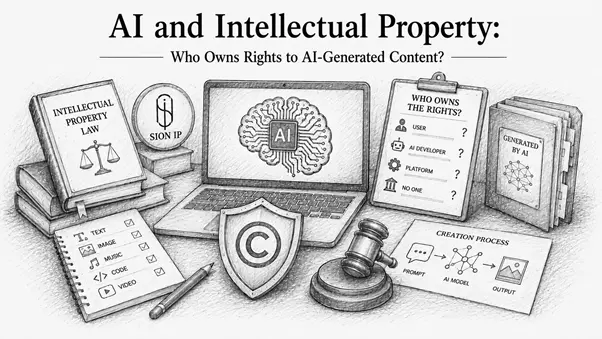
AI and Intellectual Property: Who Owns Rights to AI-Generated Content?
Generative artificial intelligence has rapidly become an integral part of modern business operations. Companies across virtually every sector now use tools such as ChatGPT, Midjourney, Stable Diffusion, GitHub Copilot, and other AI systems to create marketing materials, software code, graphic designs, business documents, and creative content.
For many organizations, generative AI offers significant commercial advantages, including lower production costs, faster content creation, and increased operational efficiency. At the same time, the widespread adoption of AI technologies has raised fundamental questions regarding intellectual property ownership.
Businesses often assume that if they pay for an AI service or enter prompts into an AI platform, they automatically own all resulting intellectual property rights. In practice, the legal landscape is considerably more complex.
There is currently no globally unified legal framework governing AI-generated content ownership. Copyright offices, courts, and legislators across different jurisdictions continue to develop their approaches, while litigation involving generative AI technologies continues to increase.
Against this backdrop, one of the most important questions facing businesses is straightforward: who owns AI-generated content, and what rights do companies actually receive when using generative AI tools?
What Qualifies as AI-Generated Content?
AI-generated content encompasses a broad range of outputs created wholly or partially with the assistance of generative artificial intelligence systems.
Common examples include:
- written articles and marketing copy;
- advertising materials;
- software code;
- logos and graphic designs;
- photographs and illustrations;
- videos and animations;
- music and sound recordings;
- presentations and business documents.
From a legal perspective, not all AI-created works should be treated identically.
Fully AI-Generated Works
Fully AI-generated works are outputs created with minimal or no meaningful human creative contribution.
Examples may include:
- a user entering a short prompt into Midjourney and publishing the resulting image without modification;
- automatically generated product descriptions created entirely by an AI platform;
- music compositions generated without human editing or arrangement.
These scenarios raise the most significant copyright ownership challenges because many legal systems require human authorship as a prerequisite for protection.
Human-Created Works Assisted by AI
By contrast, many businesses use AI as a creative tool rather than an autonomous creator.
Examples include:
- a designer using Midjourney to generate concepts and subsequently performing extensive editing;
- a marketing team employing ChatGPT to draft initial copy that is substantially rewritten by humans;
- software developers using AI-generated code suggestions that are extensively reviewed, modified, and integrated into a broader software architecture.
This distinction is legally critical. In most jurisdictions, copyright protection becomes significantly more likely when humans exercise meaningful creative control over the final work.
Who Can Be Considered the Author of AI-Generated Content?
The question of authorship lies at the center of modern AI copyright law.
Several competing legal theories have emerged.
The User as the Author
One widely discussed approach treats the user as the author of AI-generated content.
Supporters argue that users:
- formulate prompts;
- define creative objectives;
- select outputs;
- modify and curate generated material;
- make editorial decisions.
Under this theory, the human user’s creative contribution may justify copyright ownership, particularly where substantial human involvement exists.
This approach is increasingly reflected in copyright registration practices in several jurisdictions, especially where human contributions can be clearly documented.
The AI Developer as the Author
Some commentators have suggested that developers of generative AI systems should be considered authors because they design and train the underlying models.
However, this theory has gained limited support among courts, legislators, and copyright authorities.
Developers typically do not exercise creative control over individual outputs generated by users. As a result, recognizing AI developers as authors would create significant practical and legal complications.
No Author at All
A third approach concludes that certain AI-generated works simply lack an author.
Where human creative contribution is insufficient, some jurisdictions deny copyright protection altogether.
In these situations, AI-generated outputs may effectively enter the public domain immediately upon creation, leaving businesses with limited exclusive rights.
This outcome can create substantial commercial risks for companies investing heavily in AI-generated assets.
Why AI Cannot Currently Be Recognized as an Author
Modern copyright systems are overwhelmingly based on the principle of human authorship.
Neither the United States, the European Union, nor most other major jurisdictions currently recognize artificial intelligence systems as legal authors.
AI systems:
- lack legal personality;
- cannot own property;
- cannot exercise legal rights;
- cannot transfer rights;
- cannot assume legal obligations.
Consequently, AI is generally treated as a sophisticated tool rather than an independent creator.
The United States Approach to AI Copyright
The United States currently applies one of the most influential frameworks for AI copyright ownership.
The U.S. Copyright Office has repeatedly emphasized that copyright protection requires human authorship.
According to official guidance issued by the U.S. Copyright Office, works generated entirely by artificial intelligence without sufficient human creative input are generally not eligible for copyright registration.
The Office evaluates AI-assisted works on a case-by-case basis, focusing on the extent of human creative contribution.
The key question is whether a human exercised sufficient control over the expressive elements embodied in the final work.
Why Midjourney Images Cannot Always Be Registered
The U.S. Copyright Office has clarified that merely entering prompts into Midjourney or similar systems does not automatically establish authorship.
A landmark example involved the graphic novel Zarya of the Dawn. In 2023, the Copyright Office concluded that images generated through Midjourney were not independently copyrightable because the user lacked sufficient control over the system’s expressive output.
However, the Office recognized copyright protection for the human-authored text and for the overall creative selection, coordination, and arrangement of the work.
Consequently, businesses relying on Midjourney images should not assume that every generated image qualifies for full copyright protection.
Where substantial editing, compositing, retouching, or additional creative contributions are made, stronger arguments for protection may exist.
The DABUS Case and U.S. Court Decisions
The DABUS project, created by Dr. Stephen Thaler, has become one of the most significant international test cases involving artificial intelligence and intellectual property.
DABUS is an AI system that Dr. Thaler identified as the inventor of various patent applications.
U.S. courts rejected these applications, concluding that only natural persons may qualify as inventors under existing patent law.
Although the DABUS litigation primarily concerned patents rather than copyright, the underlying principle has influenced broader discussions surrounding AI authorship.
For businesses, the practical implication is clear: human involvement remains central to securing intellectual property protection in the United States.
The European Union Approach
Unlike the United States, the European Union has not adopted AI-specific copyright legislation governing ownership of AI-generated works.
Instead, existing copyright principles continue to apply.
European copyright law generally requires originality resulting from the author’s own intellectual creation.
The Court of Justice of the European Union has repeatedly emphasized that originality depends upon the expression of the author’s personality through free and creative choices.
Accordingly, fully autonomous AI outputs may struggle to satisfy the originality requirement.
Conversely, works reflecting substantial human creative choices may qualify for protection.
The European Union’s recently adopted AI Act does not establish ownership rules for AI-generated content. Instead, the legislation primarily focuses on transparency, risk management, and regulatory obligations applicable to AI systems.
Nevertheless, the AI Act may indirectly affect intellectual property practices by introducing disclosure obligations for certain providers of general-purpose AI models.
The current European trend therefore remains largely consistent with the principle of human authorship.
The United Kingdom Approach
The United Kingdom occupies a unique position in the international debate.
Unlike most jurisdictions, UK copyright legislation expressly addresses computer-generated works.
Under the Copyright, Designs and Patents Act 1988, where no human author exists, the author of a computer-generated work is deemed to be “the person by whom the arrangements necessary for the creation of the work are undertaken.”
This provision predates modern generative AI by decades, yet it has become increasingly relevant.
Despite this statutory framework, significant uncertainty remains regarding how UK courts will interpret these provisions in relation to advanced generative AI systems.
Policy debates concerning potential reform continue, particularly as the United Kingdom seeks to balance innovation with effective protection of creators’ rights.
As of June 2026, no definitive judicial framework has yet emerged for generative AI outputs under UK law.
China’s Approach to AI-Generated Content
China has emerged as one of the most closely watched jurisdictions in the field of artificial intelligence and intellectual property.
Unlike many Western jurisdictions, Chinese courts have demonstrated greater willingness to recognize copyright protection for certain AI-assisted works where meaningful human involvement can be established.
Several recent court decisions illustrate this trend.
In particular, Chinese courts have examined whether human users exercised sufficient intellectual input when creating AI-generated content. Relevant factors have included:
- prompt engineering;
- selection and refinement of outputs;
- editing and post-processing activities;
- overall creative direction.
For example, Chinese courts have recognized copyright protection for AI-assisted images where users demonstrated substantial creative choices throughout the generation process.
At the same time, Chinese authorities continue to emphasize that copyright protection does not automatically arise simply because AI tools were used.
As in other jurisdictions, human creative contribution remains highly significant.
Compared with the United States and the European Union, China’s approach may currently be viewed as somewhat more flexible. Nevertheless, businesses operating internationally should avoid assuming that copyright recognition in China will automatically extend to other jurisdictions.
Can Midjourney Images Receive Copyright Protection?
Businesses frequently ask whether Midjourney images can receive copyright protection.
The answer depends largely on the degree of human creative involvement.
Midjourney does not function like a traditional graphic design tool. Instead, the system generates images probabilistically in response to user prompts.
Consequently, the legal significance of prompts has become a central issue in AI copyright discussions.
Merely entering a short prompt such as:
“Create a futuristic city at sunset”
will rarely, by itself, establish copyright ownership under most legal systems.
However, the analysis changes where users contribute significant creative input.
Examples may include:
- developing highly sophisticated prompt sequences;
- iteratively refining outputs across numerous generations;
- selecting among multiple alternatives;
- combining several generated images;
- performing extensive editing in software such as Photoshop;
- adding original artistic elements;
- substantially modifying composition, colors, or visual effects.
The more extensive the human contribution, the stronger the argument for copyright protection.
From a business perspective, organizations should treat AI-generated images as potentially vulnerable intellectual property assets unless substantial human creative input can be demonstrated.
Businesses relying heavily on Midjourney for branding, packaging, advertising campaigns, or product designs should maintain records documenting the creative process and all subsequent modifications.
Can AI-Generated Inventions Be Patented?
Patent law presents challenges similar to those encountered in copyright law.
What Is the DABUS Project?
The DABUS project was developed by Dr. Stephen Thaler and became the first large-scale international attempt to recognize artificial intelligence as an inventor.
Patent applications identifying DABUS as the sole inventor were filed in numerous jurisdictions, including:
- the United States;
- the European Patent Office;
- the United Kingdom;
- Australia;
- South Africa.
The resulting litigation significantly influenced global AI patent law.
Why AI Is Not Recognized as an Inventor
Most major patent authorities have concluded that inventors must be natural persons.
The United States Patent and Trademark Office, the European Patent Office, and UK courts have all rejected DABUS applications on this basis.
Courts generally reasoned that:
- patent statutes contemplate human inventors;
- only natural persons can exercise legal rights and duties associated with inventorship;
- existing legislative frameworks do not recognize AI systems as legal subjects.
As of June 2026, no major Western jurisdiction recognizes AI systems as inventors.
When Patent Protection May Still Be Available
Importantly, the rejection of AI inventorship does not mean that AI-assisted innovation cannot be patented.
Patent protection may still be available where humans:
- define technical problems;
- design experiments;
- evaluate AI-generated solutions;
- select inventive concepts;
- exercise independent inventive judgment.
In practice, AI is increasingly viewed as an advanced research and development tool rather than an inventor.
Businesses using AI within innovation processes should ensure that human contributions to inventive activities are properly documented.
Business Risks Associated with AI-Generated Content
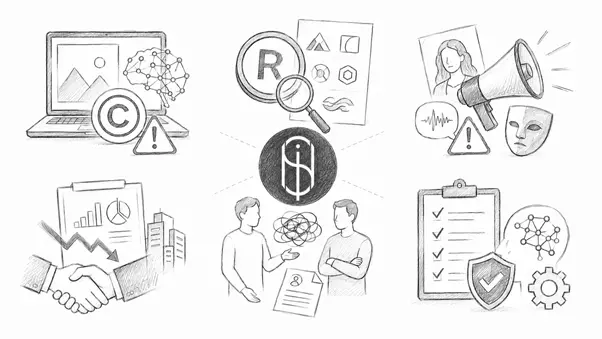
Although generative AI creates significant commercial opportunities, it also introduces substantial legal and business risks.
Copyright Infringement Risks
Many generative AI systems are trained on enormous datasets that may contain copyrighted materials.
As a result, businesses using AI-generated content may face allegations that outputs infringe third-party rights.
Numerous lawsuits involving AI developers are currently pending in the United States and other jurisdictions, including claims brought by authors, publishers, visual artists, and media companies.
Even where infringement is ultimately not established, litigation costs and reputational risks may be significant.
Trademark and Branding Risks
Businesses increasingly use generative AI to develop:
- brand names;
- logos;
- slogans;
- packaging concepts.
However, AI systems cannot guarantee that generated branding materials are legally available for use.
Organizations may inadvertently adopt names or visual elements that conflict with existing trademark rights.
Comprehensive trademark clearance searches remain essential before commercial launch.
Advertising and Marketing Risks
AI-generated advertising materials may contain:
- inaccurate statements;
- misleading claims;
- unauthorized references to third parties;
- fabricated testimonials;
- non-compliant disclosures.
Regulators in multiple jurisdictions have intensified scrutiny of AI-generated advertising practices.
Companies remain legally responsible for marketing claims, regardless of whether content was produced by humans or artificial intelligence.
Investment and M&A Risks
Investors increasingly examine AI-related intellectual property risks during due diligence processes.
Uncertainty regarding ownership of AI-generated assets may affect:
- company valuation;
- investment negotiations;
- acquisition transactions;
- licensing arrangements.
Businesses unable to demonstrate clear ownership or usage rights may encounter significant transactional obstacles.
Disputes with Contractors and Employees
AI-related ownership disputes frequently arise in relationships involving:
- employees;
- freelancers;
- marketing agencies;
- software developers;
- creative contractors.
Without properly drafted agreements, uncertainty may arise regarding ownership of AI-assisted works, prompt libraries, training datasets, and derivative materials.
Clear contractual provisions are therefore essential.
How Businesses Can Safely Use AI-Generated Content
Businesses can substantially reduce legal risks by implementing internal governance procedures.
Practical recommendations include:
Document the Creation Process
Organizations should maintain records showing:
- prompts used;
- iterative development stages;
- editing activities;
- final approval procedures.
Documentation may prove valuable during disputes or registration proceedings.
Record Human Creative Contributions
Businesses should clearly identify human contributions made during content creation.
Examples include:
- editorial decisions;
- design modifications;
- creative revisions;
- selection and arrangement of materials.
Such evidence may strengthen claims to copyright ownership.
Review Platform Terms and Licenses
AI platform terms vary significantly.
Businesses should carefully review:
- ownership provisions;
- commercial-use permissions;
- licensing restrictions;
- indemnification clauses;
- confidentiality obligations.
Terms applicable to ChatGPT, Midjourney, Stable Diffusion, and other platforms differ substantially and may change over time.
Conduct Intellectual Property Audits
Regular IP audits can help organizations identify:
- ownership gaps;
- licensing risks;
- compliance issues;
- third-party dependencies.
AI-generated assets should be included within broader intellectual property management frameworks.
Secure Rights to Modified Works
Where contractors or agencies participate in AI-assisted projects, agreements should expressly assign all intellectual property rights to the business.
This remains important even when AI tools are used extensively.
Structure Employee and Contractor Agreements Properly
Employment agreements, consultancy agreements, and service contracts should specifically address:
- AI-assisted works;
- ownership of prompts;
- ownership of datasets;
- confidentiality obligations;
- permitted use of AI tools.
Businesses adopting AI at scale should consider implementing dedicated internal AI governance policies.
The Future of AI and Intellectual Property Regulation
Artificial intelligence regulation continues to evolve rapidly.
Several trends are likely to shape future legal developments.
First, governments worldwide are increasing regulatory oversight of AI technologies.
Second, expanding case law will gradually clarify unresolved ownership questions.
Third, transparency obligations concerning AI training data, generated outputs, and synthetic content are likely to increase.
Fourth, policymakers may consider entirely new forms of protection specifically designed for AI-generated works.
Finally, businesses should expect increasing compliance obligations affecting both AI developers and commercial users.
Organizations that proactively address intellectual property risks today will likely be better positioned to adapt to future regulatory changes.
Conclusion
There is currently no unified global approach to AI-generated content ownership.
Despite significant differences among jurisdictions, most legal systems continue to rely on principles of human authorship when determining copyright ownership and inventorship.
Artificial intelligence is generally treated as a tool rather than an author or inventor.
For businesses, this means that intellectual property rights in AI-assisted works will often depend on the extent of human creative contribution and the specific legal framework applicable in relevant jurisdictions.
Organizations using generative AI should carefully evaluate intellectual property risks before commercializing AI-generated assets.
As generative AI becomes increasingly embedded within business operations, effective intellectual property management is rapidly becoming an essential component of corporate risk management and long-term value creation.
CTA
Using ChatGPT, Midjourney, or other generative AI tools in your business? SION IP can help you assess legal risks, protect intellectual property assets, and develop a comprehensive IP strategy for the AI era.
Sources
- U.S. Copyright Office — Artificial Intelligence Initiative – official guidance and policy materials on copyright and artificial intelligence, including the U.S. Copyright Office’s position on the human authorship requirement;
- Решение U.S. Copyright Office по делу Zarya of the Dawn – official administrative decision addressing the copyright status of Midjourney-generated images and the role of human creative contributio;
- European Commission — Artificial Intelligence Act – official information on the EU AI Act and the European Union’s regulatory framework for artificial intelligence;
- UK Government: Copyright and Artificial Intelligence Consultation – the UK government’s current policy position and consultation materials concerning artificial intelligence and copyright regulation;
- WIPO — AI and Intellectual Property Policy – analytical materials, policy papers, and international resources published by the World Intellectual Property Organization on artificial intelligence and intellectual property.
 08/07/2026
 08/06/2026
 05/06/2026
 05/06/2026