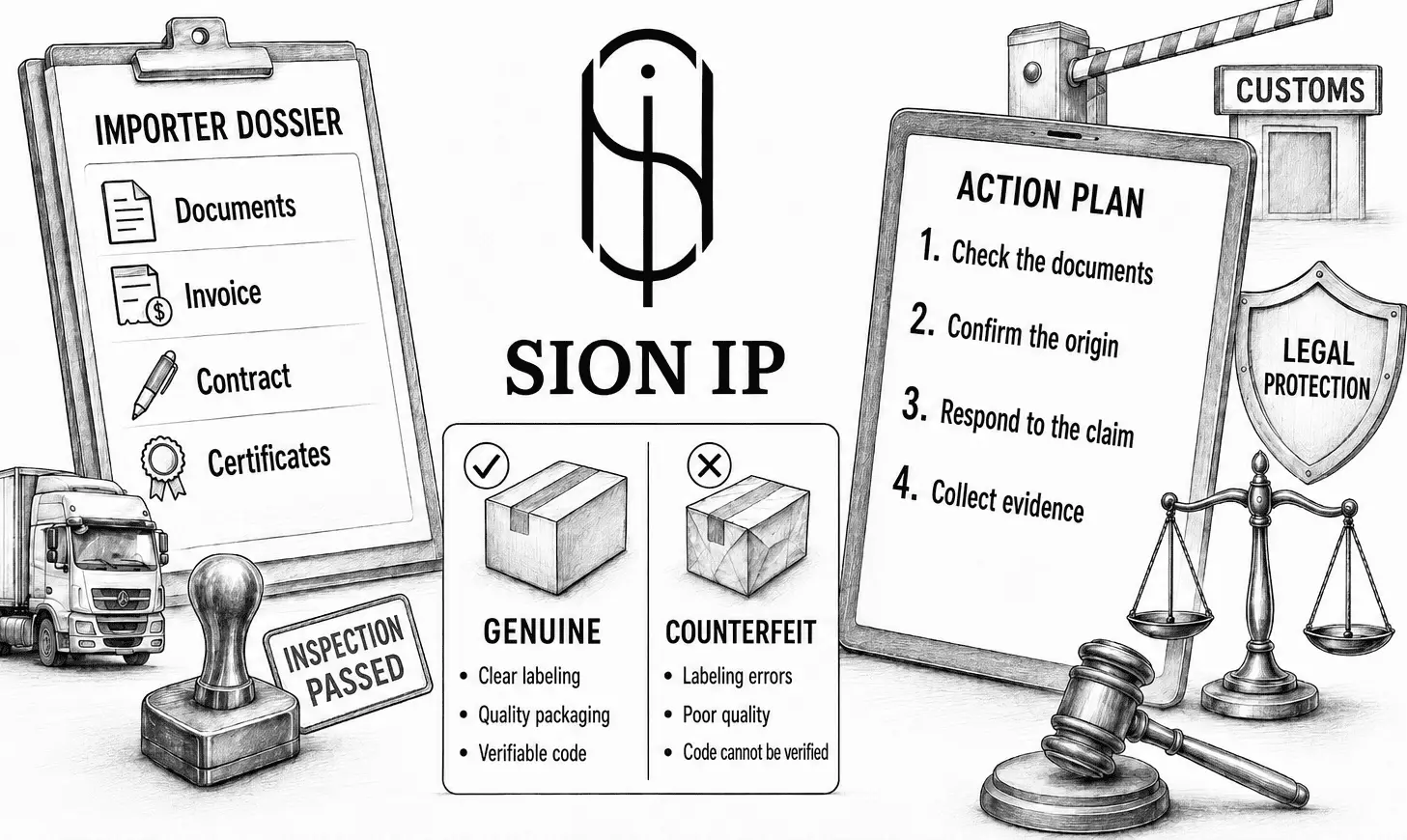
Parallel Imports and Customs Detentions: How Importers Can Respond to IP Holder Claims
When branded goods are detained by customs, the commercial impact can be immediate. Storage costs start accumulating. Demurrage and transport delays disrupt delivery schedules. Customers may claim penalties for late delivery. Seasonal products can miss the sales window. Marketplaces may suspend listings. Banks, insurers and logistics providers may ask questions. At the same time, the importer may face pressure from an IP holder claim alleging that the goods infringe trademarks, copyrights, designs or other intellectual property rights.
However, a customs detention does not automatically mean that the goods are fake.
Imported branded products may be:
- genuine goods imported outside the official distribution network;
- genuine goods that are disputed because of exhaustion of rights rules;
- genuine goods with local labelling, technical or safety compliance problems;
- counterfeit goods;
- goods affected by a separate customs classification, valuation or documentation issue.
For importers, the first task is to classify the problem correctly. Is this a counterfeit allegation? A parallel import dispute? An exhaustion of rights issue? A product compliance problem? Or a combination of several risks?
That classification determines the evidence, legal arguments, commercial options and realistic chances of obtaining customs release of goods. It also determines whether the importer should pursue release, negotiate with the rights holder, re-export the goods, correct documentation, return the shipment to the supplier or prepare for further proceedings.
This article explains how importers should approach parallel imports, customs detention, counterfeit goods allegations and intellectual property rights customs enforcement in an international trade context, with particular focus on the European Union, the United States and China.
What Are Parallel Imports?
Parallel imports are genuine branded goods imported into a market outside the official distribution channel authorized by the brand owner or other IP rights holder. In the United States and some international trade contexts, these goods are often called grey market goods.
The key point is that parallel imports are usually not fake. The goods may have been manufactured by the brand owner, by an authorized manufacturer or with the consent of the rights holder. The dispute is often not about physical authenticity, but about the import channel, the place of first sale and whether the rights holder’s control over further resale has been exhausted.
Typical parallel import scenarios include:
- cosmetics purchased from an independent distributor abroad;
- electronics bought from a supplier in another regional market;
- branded apparel sourced from surplus stock;
- spare parts purchased outside the official dealer network;
- luxury goods imported from a lower-price market;
- consumer goods intended for one country but resold in another.
Parallel imports should not be described as always legal or always illegal. Their treatment depends on the jurisdiction, the type of IP right, the place where the goods were first placed on the market, the rights holder’s consent, product differences, customs rules and local regulatory requirements.
At the WTO level, the TRIPS Agreement does not impose one global rule on exhaustion of rights. Article 6 leaves the issue largely to national or regional legal systems, meaning that countries may take different approaches to whether authorized first sale limits later IP enforcement.
National Exhaustion of Rights
Under a national exhaustion model, the rights holder’s control may be exhausted only after the product is placed on the market in that specific country by the rights holder or with its consent.
If goods are first sold abroad, the rights holder may still be able to object to their import into the domestic market. For importers, this means that proving the goods are genuine may not be enough. The importer may also need to prove that the relevant IP rights were exhausted in the country of import.
Regional Exhaustion of Rights
Regional exhaustion applies within a defined regional market. The European Economic Area is the most important example for many importers.
In simplified terms, if goods are first placed on the EEA market by the rights holder or with its consent, resale within the EEA is generally permitted. If goods are first placed on the market outside the EEA, the rights holder may object to their import into the EEA, depending on the facts and the IP right involved.
The Court of Justice of the European Union confirmed this regional approach in Silhouette International Schmied GmbH & Co. KG v Hartlauer Handelsgesellschaft mbH, rejecting a general international exhaustion rule under EU trademark law.
International Exhaustion of Rights
Under an international exhaustion model, an authorized first sale anywhere in the world may exhaust certain IP rights, at least for particular rights or product categories. This approach is not universal. It varies by jurisdiction and by the specific IP right involved.
For example, in the United States, the Supreme Court’s decision in Impression Products, Inc. v. Lexmark International, Inc. is important for patent exhaustion. The Court held that an authorized sale can exhaust patent rights in the item sold, including where the sale occurs abroad, but the analysis is specific to U.S. patent law and should not be transferred automatically to trademarks, customs procedures or other jurisdictions.
Section takeaway: parallel imports are often about the legality of the import channel and exhaustion of rights, not about whether the product is physically fake.
Parallel Imports vs Counterfeit Goods: Key Differences
The distinction between parallel imports and counterfeit goods is central to any customs detention strategy.
Parallel imports usually involve genuine goods. Counterfeit goods involve unauthorized use of a trademark or other IP right on goods that were not made by, or with the consent of, the rights holder.
| Criteria | Parallel Imports | Counterfeit Goods |
| Product origin | Genuine goods | Unauthorized or fake goods |
| Brand use | Brand applied by or with consent of the rights holder | Brand used without authorization |
| Main dispute | Import channel, exhaustion of rights, market authorization | IP infringement and unauthorized production |
| Legal assessment | Depends on jurisdiction, facts, first sale and applicable IP right | Usually treated as infringement |
| Evidence needed | Supply chain, first sale, authenticity documents, exhaustion analysis | Marking, source, product inspection, counterfeit indicators |
| Possible outcome | Release, settlement, re-export, relabelling, dispute | Seizure, destruction, liability, import ban |
Practical Example
A company imports genuine branded sneakers purchased from an authorized distributor in another country. The brand owner objects because the importer is not part of the official local distribution network. This may be a parallel import issue.
By contrast, if the sneakers were manufactured by an unrelated factory using the brand’s trademark without authorization, the issue is counterfeit goods.
The legal response is different. In the first case, the importer must prove authenticity and assess whether importation is permitted under the applicable exhaustion rules. In the second case, the importer may face seizure, destruction, liability and potentially broader enforcement consequences.
Section takeaway: the importer’s first task is to prove whether the goods are genuine and then separately assess whether their import is allowed in the relevant jurisdiction.
What Counts as Counterfeit Goods at the Border?

In customs and IP enforcement, counterfeit goods usually involve unauthorized use of a trademark on goods or packaging in a way that infringes rights in the country of import.
TRIPS Article 51 requires WTO members to provide border procedures at least for the importation of counterfeit trademark goods and pirated copyright goods. The TRIPS note defines counterfeit trademark goods as goods, including packaging, bearing without authorization a trademark that is identical to or cannot be distinguished in its essential aspects from a validly registered trademark for such goods, thereby infringing the trademark owner’s rights under the law of the importing country.
This does not mean every commercial dispute with a brand owner is a counterfeit case.
The following facts do not automatically prove counterfeiting:
- the goods were imported outside the official distribution network;
- the importer has no contract with the official distributor;
- the goods are cheaper than the local market version;
- the brand owner dislikes the sales channel;
- there is a distribution conflict;
- there is a patent, design, licence or contractual dispute;
- the goods have labelling or compliance problems;
- the packaging differs from the local market version.
Before accepting a counterfeit allegation, the importer should identify:
- Which IP right is allegedly infringed — trademark, copyright, design, patent or another right.
- Whether the goods are physically fake or genuine.
- Whether the goods were made by or with consent of the rights holder.
- Whether exhaustion of rights may apply.
- Whether product compliance issues are being confused with IP issues.
- What evidence the IP holder has provided.
- What customs procedure and deadlines apply.
A customs authority may suspend release because goods are suspected of infringing IP rights, but customs may not always decide the underlying civil IP dispute in the same way a court would. The exact procedure depends on the jurisdiction.
Why Customs May Detain Branded Goods
Customs detention may arise for several reasons. Importers should separate IP-based detention from product compliance, safety, customs classification and documentation issues.
IP-Based Detention
Customs may suspend release where:
- the IP holder has recorded rights with customs;
- the IP holder filed an application or complaint;
- the goods appear to bear a protected trademark, design or copyright-protected feature;
- customs suspects counterfeit goods;
- there is a dispute over parallel imports;
- the goods resemble protected products or packaging;
- the shipment may fall within an import exclusion order;
- customs has information from the rights holder, previous seizures or risk profiling.
In the EU, customs IP enforcement is structured under Regulation (EU) No 608/2013, which concerns customs enforcement of intellectual property rights and replaced the earlier Regulation 1383/2003.
In the United States, CBP intellectual property enforcement is heavily linked to recordation of federally registered trademarks and copyrights. CBP’s e-Recordation program allows trademark and copyright owners to obtain border enforcement, and CBP guidance describes detention, seizure and exclusion authority for infringing goods.
In China, customs IP protection also relies significantly on recordation. China Customs materials state that recordation for customs protection of an intellectual property right is valid for 10 years from approval and may be renewed, while procedural rules address detention of suspected infringing goods and notification of rights holders.
Product Compliance or Technical Regulation Issues
Detention may also be unrelated to IP rights. Common non-IP reasons include:
- incorrect labelling;
- missing declaration of conformity;
- missing technical file;
- CE marking import compliance issues in the EU;
- wrong language on product instructions;
- safety documentation problems;
- incorrect importer details;
- wrong customs classification;
- missing test reports;
- product safety concerns;
- incomplete certificates or declarations.
A product may be genuine from an IP perspective but still non-compliant from a regulatory or product safety perspective.
For the EU, CE marking requires particular care. CE marking is required only for products covered by EU harmonised legislation that specifically mandates it; if such requirements do not apply to the product, CE marking must not be used. The European Commission also emphasizes that importers and distributors help ensure that products placed on the EEA market comply with EU rules and, where required, bear CE marking.
Section takeaway: IP risks and compliance risks require different evidence, different arguments and different corrective actions.
What Should an Importer Do If Goods Are Detained by Customs?
The first days after customs detention are often decisive. A poor initial response can increase storage costs, weaken the legal position and make settlement more difficult.
Step 1. Identify the Legal Basis for the Detention
The importer should immediately determine:
- which authority suspended release;
- the legal basis for the detention;
- whether an IP holder claim was filed;
- which IP right is involved;
- whether the issue concerns trademark, design, patent, copyright or another right;
- whether there are separate compliance issues;
- what deadlines apply;
- whether the goods are at risk of seizure, destruction or further proceedings.
A wrong initial classification can damage the defence strategy.
For example, an importer may spend valuable time proving authenticity when the actual issue is missing conformity documentation. Or the importer may focus on relabelling while the real issue is a rights holder’s trademark objection.
Step 2. Collect Evidence That the Goods Are Genuine
Authenticity is usually proven through a package of evidence, not a single document. The importer should collect:
- purchase agreements;
- supplier contracts;
- invoices;
- packing lists;
- transport documents;
- product photos;
- packaging photos;
- serial numbers;
- QR codes or barcode data;
- correspondence with the supplier;
- evidence of first sale;
- certificates of origin, where relevant;
- distributor documents;
- proof that the supplier is part of a legitimate supply chain;
- batch information;
- SKU data;
- warranty documents;
- product manuals;
- pre-shipment inspection records.
This evidence should be collected quickly because customs deadlines are often short, and storage costs may increase daily.
Step 3. Separate Authenticity from the Right to Import
Proving that goods are genuine does not always resolve the case.
There are four common scenarios:
- Goods are genuine and lawfully importable.
The importer may focus on release, evidence submission and customs communication. - Goods are genuine but imported into a jurisdiction where the rights holder may object.
The issue may turn on exhaustion of rights, first sale, consent or material differences. - Goods are genuine but fail local labelling or compliance requirements.
The importer may need corrective action, relabelling, documentation or regulatory review. - Goods are counterfeit or the supply chain cannot be verified.
The importer may need to assess liability, supplier claims, destruction, re-export, settlement or defence against enforcement action.
Each scenario requires a different response.
Step 4. Separate IP Claims from Compliance Claims
For IP claims, check:
- trademark rights;
- design rights;
- patent risks;
- copyright claims;
- customs recordation;
- exhaustion of rights;
- rights holder consent;
- first sale evidence;
- import exclusion orders.
For compliance claims, check:
- product labels;
- declarations of conformity;
- technical files;
- safety documentation;
- importer details;
- user instructions;
- product classification;
- market-specific rules.
The same shipment may raise both IP and compliance issues. For example, a genuine electronic device may be disputed as a parallel import and also lack the correct EU declaration of conformity or importer labelling.
Step 5. Communicate Carefully with the IP Holder
Communication with the IP holder may help resolve the dispute, but careless wording can harm the importer.
The importer should avoid:
- admitting infringement without legal analysis;
- describing the goods as “counterfeit” unless confirmed;
- disclosing unnecessary commercial information;
- making emotional accusations;
- agreeing to destruction without understanding the consequences;
- making factual claims that cannot be supported by documents.
Possible resolution options include:
- providing authenticity evidence;
- clarifying the supply chain;
- correcting labelling;
- re-exporting goods;
- returning goods to the supplier;
- limiting sales territory;
- negotiating a settlement;
- agreeing to destruction only where infringement is confirmed or commercially unavoidable.
Step 6. Decide Whether Release Is Legally and Commercially Realistic
The importer should assess whether to pursue:
- release of the goods;
- settlement with the rights holder;
- re-export;
- return to supplier;
- corrective labelling or documentation;
- court or administrative challenge;
- continuation of the customs procedure;
- supplier claim for damages or indemnity.
The goal is not simply to argue with the rights holder. The goal is to choose the legally and commercially rational path based on evidence, deadlines, costs and risk exposure.
Practical CTA: If branded goods are detained by customs or an IP holder has raised an objection, the first step is to classify the issue correctly: counterfeit allegation, parallel import dispute, exhaustion of rights issue or product compliance problem. That classification determines the evidence, strategy and realistic options for release or settlement.
EU, US and China: Why the Approach Differs
Importers should not assume that a strategy that works in one jurisdiction will work elsewhere.
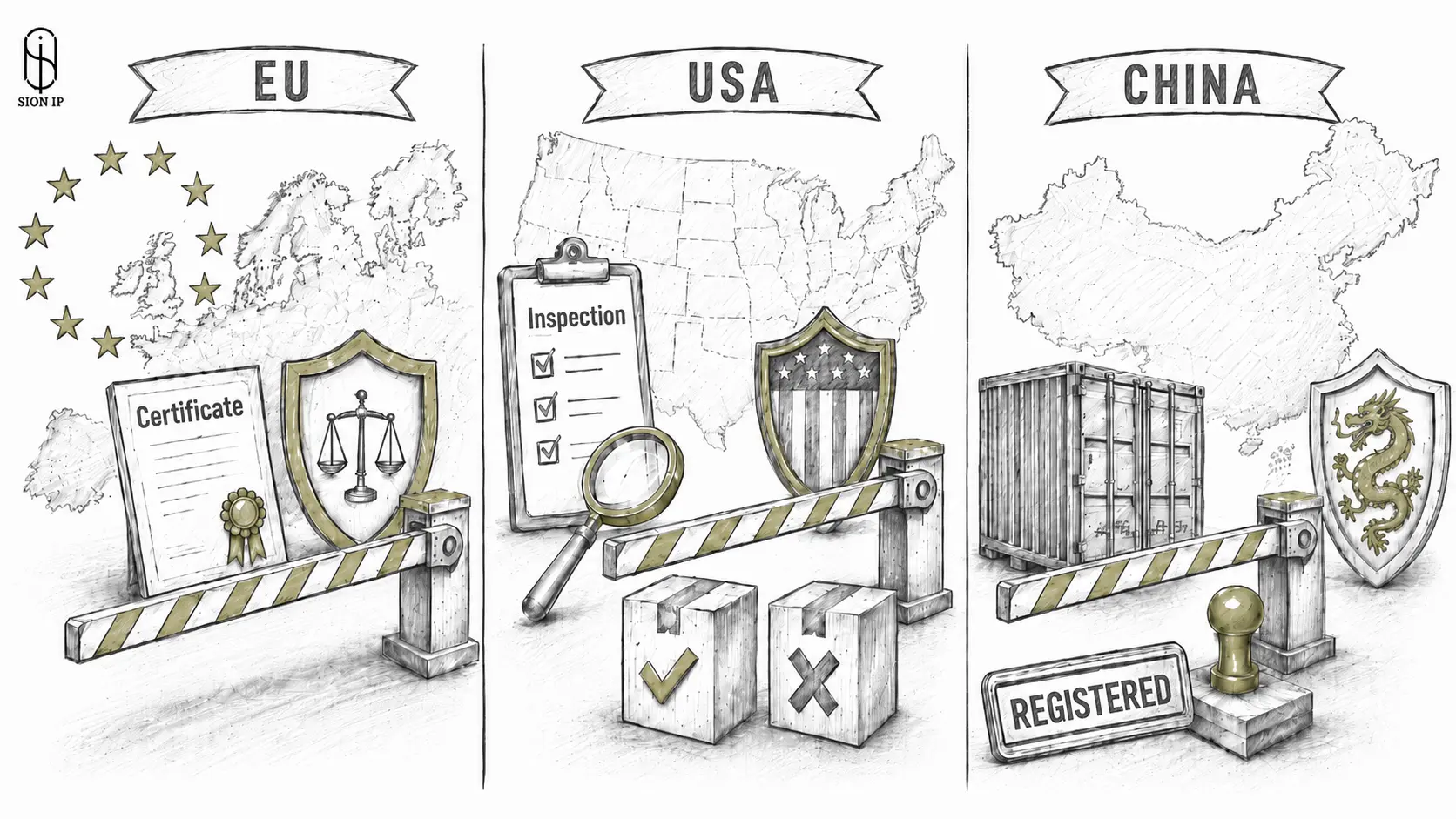
| Jurisdiction | Key issue | Main risk for importer | Practical focus |
| EU / EEA | Regional exhaustion | Goods first sold outside the EEA may be blocked | Prove first EEA sale or consent |
| United States | Material differences, CBP recordation, Section 337 | Genuine goods may still be restricted if materially different or subject to exclusion orders | Check product differences, recordations and ITC orders |
| China | Customs IP recordals and local enforcement practice | Short response timelines and trademark-focused enforcement | Check local IP registrations, recordals and procedure |
European Union: Regional Exhaustion of Rights
The EU/EEA applies a regional exhaustion model for trademarks. First placement on the EEA market by the rights holder or with its consent is critical. Goods first placed on the market outside the EEA may be subject to rights holder objection when imported into the EEA.
The Silhouette judgment remains a key reference for the EU approach because it rejected a broader international exhaustion rule under EU trademark law.
Even where goods have been lawfully placed on the EEA market, problems may still arise if the goods are altered, repackaged, damaged, relabelled or sold in a manner that may affect the brand’s reputation, depending on the facts and applicable case law.
Practical takeaway: for the EU, the importer should verify where the goods were first placed on the market and whether the rights holder consented to placement on the EEA market.
United States: Material Differences and Customs IP Enforcement
The U.S. approach depends on the IP right involved.
For patents, Impression Products v. Lexmark is important because the Supreme Court recognized patent exhaustion after authorized sales, including foreign sales, in the circumstances addressed by that case.
For trademarks, importers should pay close attention to material differences between imported goods and U.S.-market goods. Material differences may include:
- packaging;
- warranty coverage;
- instructions;
- formulation;
- safety warnings;
- labelling;
- product composition;
- regulatory approvals;
- consumer expectations.
CBP recordation is also important. CBP allows rights holders to record trademarks and copyrights for border enforcement, and CBP guidance identifies intellectual property enforcement as a priority area.
Importers should also consider Section 337 investigations before the U.S. International Trade Commission. The ITC states that the primary remedy in Section 337 investigations is an exclusion order directing Customs to stop infringing imports from entering the United States.
Practical takeaway: for the U.S., genuine goods are not automatically risk-free. Material differences, CBP recordation and Section 337 exclusion orders should be assessed before shipment.
China: Customs IP Recordals and Short Response Timelines
China requires separate jurisdiction-specific analysis. Local trademark registrations, customs IP recordals and enforcement practice matter.
China Customs materials describe recordation for customs protection of intellectual property rights and the detention of suspected infringing goods. Recordation may be valid for 10 years, and customs rules address notification of rights holders when suspected infringing goods are detained.
Importers should not copy EU or U.S. logic into China without checking local law, registration status, product category risk and current customs procedures. In practice, trademark issues, local registration ownership, evidence quality and procedural speed can be critical.
Practical takeaway: for China, importers should check local IP registrations, customs recordals, product category risks and current customs procedure requirements before shipment.
How to Distinguish Genuine Goods from Counterfeit Goods
To distinguish genuine goods from counterfeit goods, the importer must build a consistent evidentiary chain. Authenticity is rarely proven by one invoice alone. Customs, rights holders and courts may look at the full commercial and product record.
Check the Source of the Goods
The importer should verify:
- who the supplier is;
- whether there is a written contract;
- whether the supplier is a legitimate market participant;
- where the goods were purchased;
- whether the supply chain is traceable;
- whether the goods come from authorized, surplus, liquidation or secondary channels;
- whether the lot may be mixed with questionable goods;
- whether the supplier can explain the source of the goods.
A supplier that refuses to provide basic documents, cannot explain product origin or offers unusually low prices without a commercial explanation creates risk.
Check Marking, Packaging and Product Features
The importer should examine:
- trademark placement;
- serial numbers;
- QR codes;
- barcodes;
- SKU data;
- packaging quality;
- product labels;
- language of instructions;
- warranty cards;
- batch numbers;
- tamper seals;
- comparison with official product images;
- consistency across the shipment.
Minor packaging differences do not automatically prove counterfeiting. Goods intended for different markets may have different language, warranty terms or packaging. However, inconsistencies should be investigated before shipment.
Check Commercial and Transport Documents
Key documents include:
- invoices;
- contracts;
- purchase orders;
- packing lists;
- bills of lading or air waybills;
- certificates of origin, where relevant;
- documents confirming first sale;
- distributor documentation;
- technical documentation;
- conformity documents;
- warehouse records;
- inspection reports.
The documents should tell a coherent story. If the invoice, packing list, product codes and transport documents contradict one another, the importer’s position becomes weaker.
Check Digital Traces
Digital evidence may include:
- serial number verification with the manufacturer, where available;
- supplier correspondence;
- batch history;
- pre-shipment product photos;
- product database checks;
- marketplace or distribution history;
- logistics tracking;
- electronic purchase records.
Digital traces can be particularly useful where the rights holder alleges counterfeiting but the importer believes the products are genuine grey market goods.
Section takeaway: authenticity is built through a consistent evidentiary chain: supplier, documents, product identifiers, packaging, first sale and compliance records.
How to Reduce Risk Before Shipment
The strongest importer defence usually starts before the goods cross the border. Once customs has detained the shipment, the importer is reacting under time pressure.
Prepare an IP Dossier
An IP dossier should include:
- product origin;
- supply chain documents;
- evidence of first sale;
- proof of authenticity;
- supplier information;
- product and packaging photos;
- serial numbers;
- any authorization or distributor documents;
- analysis of exhaustion of rights;
- review of relevant trademarks, designs, copyrights or patents;
- assessment of customs recordation risk.
For EU-bound goods, the dossier should focus on EEA first sale and consent. For U.S.-bound goods, it should address material differences and CBP recordation. For China-bound goods, it should review local IP registrations and customs recordals.
Prepare a Compliance Dossier
A compliance dossier should include:
- declarations of conformity;
- technical documentation;
- product labels;
- safety documentation;
- instructions;
- test reports;
- customs classification;
- importer details;
- CE marking analysis for the EU, where applicable;
- product-specific regulatory requirements.
This is especially important for electronics, machinery, toys, medical devices, cosmetics, PPE, batteries and other regulated goods.
Check Customs IP Recordals
Before shipment, the importer should check:
- whether the trademark or other IP right is recorded with customs;
- who the rights holder is;
- whether the rights holder actively enforces at the border;
- whether similar goods have been blocked before;
- whether the product category is high risk;
- whether exclusion orders or special restrictions apply.
In the U.S., CBP’s e-Recordation program is a key reference point for recorded trademarks and copyrights. In China, customs IP recordation can be central to border enforcement.
Verify the Supplier
The importer should assess:
- supplier reputation;
- source of the goods;
- history of prior shipments;
- right to dispose of the goods;
- documentation quality;
- risk of mixed lots;
- contractual warranties;
- indemnities for IP claims, counterfeit allegations and customs detention;
- cooperation obligations if customs asks for evidence.
Supplier contracts should address what happens if goods are detained, rejected, seized or found non-compliant.
Assess Jurisdiction-Specific Risks
Before shipping branded goods through non-official channels, importers should review the supply chain, customs recordals, exhaustion of rights and compliance documentation for each target market.
In practice:
- EU: focus on EEA first sale, consent and product compliance.
- U.S.: focus on material differences, CBP recordation and Section 337 risk.
- China: focus on local IP registrations, customs recordals and procedural timelines.
Section takeaway: pre-shipment analysis often determines whether the importer can defend the shipment if a customs dispute arises.
Common Mistakes Importers Make
Mistake 1. Treating Customs Detention as Proof of Counterfeiting
A detention is a warning signal, not a final conclusion. If the importer assumes guilt too early, it may take a weak position, agree to unnecessary destruction or fail to challenge an inaccurate allegation.
Mistake 2. Confusing Parallel Imports with Counterfeit Goods
Parallel imports and counterfeit goods require different evidence. In a parallel import case, supply chain, first sale and exhaustion of rights may be central. In a counterfeit case, product authenticity and unauthorized manufacture are the core issues.
Mistake 3. Ignoring Customs Deadlines
Customs IP procedures often move quickly. Missing a deadline may allow the process to continue without the importer’s evidence, increasing the risk of seizure, destruction or escalation.
Mistake 4. Communicating with the IP Holder Without a Legal Position
Careless wording may be interpreted as an admission. Before contacting the rights holder, the importer should understand the legal basis of the claim, the evidence available and the commercial objective.
Mistake 5. Failing to Document the Supply Chain
Without reliable documents, it becomes difficult to prove authenticity, lawful origin or exhaustion of rights. This is especially problematic where the importer purchased through several intermediaries.
Mistake 6. Mixing IP Issues with Product Compliance Issues
A genuine product can still be non-compliant. A non-compliant product is not automatically counterfeit. The importer must separate IP, customs and regulatory issues.
Mistake 7. Applying the Same Strategy in Every Country
A strategy that works in the EU may fail in the U.S. or China. Exhaustion of rights, customs recordation, trademark enforcement, product compliance and procedural timelines differ significantly.
Section takeaway: the most expensive mistakes often happen in the first days after detention, when the importer acts without classifying the problem correctly.
When Legal Support Is Important
Legal support is especially important where:
- goods are detained after an IP holder claim;
- the importer must prove authenticity quickly;
- the rights holder alleges counterfeiting;
- trademarks, designs, patents or copyrights are involved;
- customs deadlines are short;
- the shipment involves the EU, U.S., China or multiple jurisdictions;
- product compliance issues overlap with IP issues;
- the importer needs to negotiate with the rights holder;
- the value of the goods or commercial risk is significant;
- future shipments may face the same objection.
Legal counsel can help to:
- classify the customs issue correctly;
- separate parallel import, counterfeit and compliance risks;
- prepare evidence for customs;
- assess exhaustion of rights;
- review customs recordals;
- communicate with the rights holder;
- evaluate release, settlement, re-export, return or destruction options;
- prepare a pre-shipment risk assessment for future imports;
- review supplier warranties and indemnities.
The practical value is not only legal argument. It is strategic risk control. The importer must decide whether fighting for release is realistic, whether settlement is cheaper, whether re-export is safer, or whether the supplier should bear the loss.
Conclusion
Parallel imports and counterfeit goods are different legal situations. A customs detention or IP holder objection does not automatically prove that the goods are fake.
For importers of branded goods, the key issue is to classify the problem quickly and accurately. The importer must determine whether the case concerns counterfeit goods, a parallel import dispute, exhaustion of rights, customs recordation, product compliance or several issues at the same time.
Authenticity evidence is critical, but it may not be enough. The importer may also need to prove first sale, rights holder consent, lawful supply chain, correct labelling, product conformity and compliance with local customs procedures.
The EU, U.S. and China apply different approaches. The EU focuses heavily on regional exhaustion and EEA first sale. The U.S. requires attention to material differences, CBP recordation and Section 337 exclusion orders. China requires local analysis of IP registrations, customs recordals and enforcement procedures.
For importers, the key question is not only whether the goods are genuine, but whether the evidence, supply chain, labelling, first sale and applicable law support their release in the target market. The earlier this position is prepared, the better the importer’s chances of protecting the shipment and reducing losses.
Disclaimer
This article is for informational purposes only and does not constitute legal advice. The legal assessment of parallel imports, counterfeit goods, customs detention and IP rights depends on the specific facts, product category, jurisdiction, applicable law and customs procedure. Current customs deadlines and procedural requirements should be verified before taking action.
Sources and References
- WTO. Agreement on Trade-Related Aspects of Intellectual Property Rights — TRIPS Agreement. – Article 6 addresses the issue of exhaustion of rights. Article 51 covers customs procedures and the concepts of counterfeit trademark goods and pirated copyright goods.
- WTO. TRIPS Agreement — Enforcement of Intellectual Property Rights. – This section explains border measures, suspension of the release of goods, and the definition of counterfeit goods in the customs context.
- Regulation (EU) No 608/2013 — Article 23. – Article 23 sets out the timelines and procedure for the destruction of goods suspected of infringing intellectual property rights under customs control. It is relevant to the section on how an importer should respond after customs detention.
- Court of Justice of the European Union. Silhouette International Schmied GmbH & Co. KG v Hartlauer Handelsgesellschaft mbH, C-355/96. – A key CJEU case on regional exhaustion of rights in the EU and the rejection of international exhaustion under EU law.
- Supreme Court of the United States. Impression Products, Inc. v. Lexmark International, Inc., 581 U.S. 360, 2017. – A U.S. Supreme Court decision on patent exhaustion and the effect of a first authorized sale, including a foreign sale, on the patent owner’s rights.
- European Commission. CE marking. – The official European Commission section on CE marking. It explains which products require CE marking and clarifies that CE marking is not a mark of origin or proof of approval by EU authorities.
- European Commission. CE marking — Importers and distributors. – This section explains the obligations of importers and distributors in the EU, including checking product conformity, documentation, and correct marking before placing products on the EU market.
- U.S. Customs and Border Protection. Intellectual Property Rights — IPR Enforcement. – The official CBP section on customs enforcement of trademarks and copyrights, the e-Recordation Program, and intellectual property rights enforcement at the U.S. border.
- U.S. International Trade Commission. About Section 337. – This section explains Section 337 investigations, import exclusion orders, and unfair trade practices involving imported goods, including infringement of patents, trademarks, and other intellectual property rights.
 08/07/2026
 07/07/2026
 08/06/2026
 05/06/2026