Trademark Protection on Marketplaces: Amazon, Allegro, Etsy and Beyond
Natalia Riazanova
Cross-border e-commerce has transformed the way businesses reach customers. Today, even small brands can sell products globally through marketplaces such as Amazon, Etsy, Allegro, eBay, Walmart Marketplace, and numerous niche platforms.
However, international expansion through online marketplaces also exposes businesses to significant intellectual property risks. Counterfeit products, unauthorized use of trademarks, copied product listings, and brand impersonation have become widespread across virtually all major e-commerce platforms.
For many sellers, trademark infringement is no longer merely a legal issue—it is a direct commercial threat. Unauthorized sellers can divert sales, damage customer trust, dilute brand value, and undermine years of investment in brand development.
As competition intensifies, marketplace sellers increasingly need a proactive intellectual property strategy rather than reacting only after infringement occurs. Businesses that understand how marketplace enforcement systems operate and secure trademark protection early are typically better positioned to prevent infringement, preserve customer trust, and support international growth.
Why Brand Protection on Marketplaces Matters
Many businesses underestimate the importance of intellectual property protection when entering online marketplaces. In practice, delaying trademark registration often creates substantial business risks.
Reputational Damage
Consumers typically associate poor-quality counterfeit products with the legitimate brand owner. Even when a business is not responsible for counterfeit goods, negative reviews and customer complaints may damage its reputation.
A damaged reputation can be particularly costly in e-commerce, where customer trust, ratings, and reviews strongly influence purchasing decisions.
Lost Sales
Counterfeiters and unauthorized sellers frequently compete directly with legitimate businesses, often undercutting prices and diverting customers.
As a result, genuine brand owners may lose not only immediate revenue but also long-term customer relationships.
Customer Confusion
Lookalike brands, copied listings, and unauthorized trademark use may create confusion among consumers regarding product origin, authenticity, or affiliation.
Confused customers may purchase inferior products believing they originate from the legitimate business, ultimately harming brand loyalty.
Marketplace Account Risks
Some marketplaces require proof of intellectual property ownership during disputes. Businesses without registered trademark rights may struggle to defend their listings or may even face account suspensions.
Moreover, sellers operating without trademark protection may encounter difficulties when enrolling in marketplace protection programs.
Long-Term Brand Dilution
Failure to enforce trademark rights can weaken brand distinctiveness over time and significantly reduce overall brand value.
For these reasons, intellectual property protection should be considered before launching products on any marketplace.
Common Trademark Violations on Marketplaces
Online marketplace trademark infringement can take multiple forms.
Counterfeit Products
Counterfeit goods are products intentionally designed to imitate genuine branded products without authorization.
Typical examples include:
- fake branded accessories;
- unauthorized cosmetics;
- imitation electronics;
- counterfeit apparel.
Counterfeiting typically infringes trademark rights and may additionally violate design rights, copyrights, and unfair competition laws.
In severe cases, counterfeit products may also create product safety risks, exposing legitimate businesses to reputational harm and potential regulatory scrutiny.
Unauthorized Use of Trademarks
Some sellers use another company’s trademark within product titles, descriptions, packaging, or storefront names without authorization.
Examples include:
- using a competitor’s trademark in listing titles;
- falsely claiming compatibility or affiliation;
- incorporating another company’s logo into marketing materials.
Such activities often constitute trademark infringement and may violate marketplace policies.
Copied Product Listings
Competitors may copy existing product listings, including titles, descriptions, and brand identifiers.
While factual product information generally cannot be protected, copied creative content may infringe copyright, while misuse of brand identifiers may infringe trademark rights.
In practice, copied listings frequently combine multiple forms of infringement.
Unauthorized Use of Product Images and Descriptions
Product photographs, videos, and marketing copy are often protected by copyright.
Unauthorized reproduction may violate:
- copyright law;
- trademark law;
- unfair competition regulations.
Professional product photography and original marketing materials often represent significant business investments and should be actively protected.
Lookalike Brands and Consumer Confusion
Some businesses intentionally adopt similar names, logos, packaging, or visual identity elements to benefit from an established brand’s reputation.
Even if the trademarks are not identical, confusing similarity may still constitute infringement under applicable laws.
How Amazon Brand Registry Works
Amazon Brand Registry is Amazon’s primary brand protection program designed to help rights holders protect and manage their intellectual property on the platform.
The program offers both preventive and enforcement tools.
Key benefits include:
- enhanced brand protection mechanisms;
- proactive counterfeit detection;
- accelerated infringement reporting;
- automated removal tools;
- greater control over product listings.
Once enrolled, brand owners gain access to dedicated reporting systems allowing them to identify and remove infringing listings more efficiently.
Amazon also uses machine-learning technologies to proactively detect potentially infringing listings before they become visible to consumers.
Additional commercial advantages include:
- A+ Content;
- Sponsored Brands advertising;
- Brand Stores;
- advanced analytics;
- customer engagement tools.
Eligible brands may also gain access to additional anti-counterfeiting solutions.
Amazon Transparency uses unique product codes that help authenticate genuine goods throughout the supply chain and reduce the risk of counterfeit products reaching consumers.
Amazon Project Zero allows qualifying brands to remove certain counterfeit listings directly without waiting for Amazon’s review. Access to Project Zero depends on Amazon’s eligibility criteria and seller history.
Together, these programs provide not only the trademark protection Amazon sellers require but also valuable tools for long-term brand management and customer engagement.
Trademark Requirements for Amazon Brand Registry
Businesses frequently ask whether they need a trademark for Amazon sellers.
The answer depends on jurisdiction and Amazon’s current eligibility requirements.
What Types of Trademarks Are Accepted
Amazon generally accepts:
- word trademarks;
- figurative trademarks containing textual elements;
- combined trademarks featuring brand wording.
The trademark should correspond to the brand displayed on products or packaging.
Eligible Jurisdictions
Amazon recognizes trademarks issued by approved national and regional intellectual property offices.
Examples include:
- United States Patent and Trademark Office (USPTO);
- European Union Intellectual Property Office (EUIPO);
- UK Intellectual Property Office (UKIPO);
- German Patent and Trade Mark Office (DPMA);
- numerous additional national trademark offices.
Amazon periodically updates the list of recognized trademark offices. Businesses should therefore verify current eligibility requirements before applying for Amazon Brand Registry.
Can Pending Applications Be Used?
Amazon generally accepts active registered trademarks for Brand Registry enrollment.
In certain jurisdictions, pending trademark applications may also qualify, particularly when filed through Amazon IP Accelerator or where Amazon expressly recognizes pending applications.
Because eligibility rules vary by country and are updated periodically, businesses should verify current requirements directly with Amazon before applying.
Importantly, a trademark application is not equivalent to a registered trademark. Registration generally provides stronger enforcement rights and broader protection against infringement.
What Is Amazon IP Accelerator?
Amazon IP Accelerator connects sellers with vetted law firms authorized to file trademark applications.
Participating sellers may obtain accelerated access to Amazon Brand Registry before full trademark registration is completed.
For rapidly growing e-commerce businesses, Amazon IP Accelerator can significantly shorten the timeline for obtaining brand protection Amazon tools.
Brand Protection Tools on Etsy, Allegro, and Other Platforms
Although Amazon offers one of the most sophisticated ecosystems, other marketplaces also provide intellectual property protection mechanisms. The main options sellers rely on today are Amazon Brand Registry, Etsy’s IP infringement reporting process, Allegro’s brand protection panel, and eBay’s VeRO program — each described below.
Etsy Intellectual Property Policy
Etsy maintains formal procedures for reporting intellectual property infringement.
Rights holders may submit notices regarding:
- trademark infringement;
- copyright infringement;
- counterfeit goods.
Etsy primarily relies on rights holders to report infringements, although the platform also employs automated compliance and enforcement mechanisms in certain circumstances.
Trademark registration significantly strengthens enforcement efforts on Etsy.
Brand Protection Mechanisms on Allegro
Allegro, one of Central Europe’s largest marketplaces, enables rights holders to report violations through dedicated infringement reporting systems.
Businesses operating in Poland and across the European Union should consider securing trademark rights before entering the platform.
EU trademark registration often provides efficient regional protection for Allegro sellers.
eBay VeRO and Other Marketplace Programs
eBay’s Verified Rights Owner (VeRO) program allows intellectual property owners to request removal of infringing listings.
Comparable programs also exist on:
- Walmart Marketplace;
- Alibaba;
- AliExpress;
- Mercado Libre.
Despite procedural differences, most platforms require evidence demonstrating ownership of intellectual property rights.
What to Do If Competitors Copy Your Product Listing
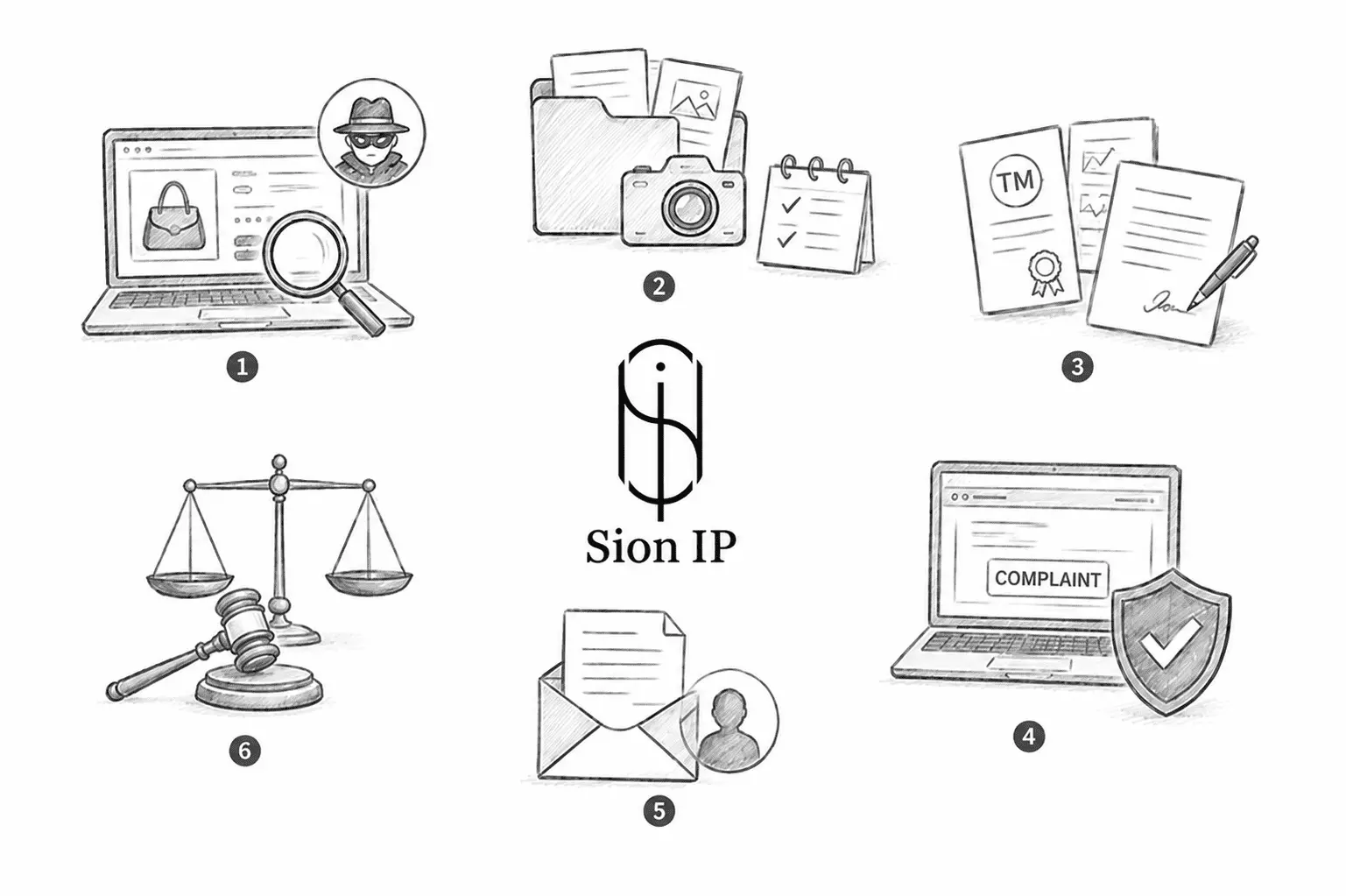
Businesses frequently discover copied product listings after achieving commercial success.
A structured response strategy is essential.
Step 1: Document the Infringement
Collect comprehensive evidence, including:
- screenshots;
- URLs;
- seller information;
- timestamps;
- purchase records where appropriate.
Evidence should be preserved before notifying the infringer.
Step 2: Determine Which Rights Are Infringed
Assess whether the infringement concerns:
- trademarks;
- copyrights;
- industrial designs;
- unfair competition.
Different rights may require different enforcement procedures.
Step 3: Submit Marketplace Complaints
Most marketplaces provide formal complaint systems.
When filing a complaint:
- identify the infringed rights;
- provide registration certificates where applicable;
- explain the violation clearly;
- attach supporting evidence.
Step 4: Contact the Infringer
In some situations, direct communication may resolve the dispute quickly.
However, communications should be carefully drafted to avoid unintended legal consequences.
Step 5: Send a Cease and Desist Letter
A professionally prepared cease and desist letter often results in voluntary compliance.
The letter typically:
- identifies the infringed rights;
- demands cessation of infringing activities;
- requests removal of listings;
- sets deadlines;
- reserves legal remedies.
Step 6: Escalate Legal Action
If informal measures fail, businesses may consider:
- court proceedings;
- preliminary injunctions;
- damages claims;
- customs enforcement measures.
How to Combat Counterfeit Goods on Marketplaces
Counterfeit goods on marketplaces require a multi-layered enforcement strategy.
Marketplace Enforcement Tools
Rights holders should actively use available reporting systems such as:
- Amazon Brand Registry;
- Amazon Project Zero;
- eBay VeRO;
- Etsy infringement reporting;
- platform-specific brand protection programs.
Trademark-Based Takedown Procedures
Registered trademarks remain among the most effective tools for removing counterfeit products from online marketplaces.
Trademark-based complaints generally produce faster and more predictable outcomes.
Cease and Desist Letters
Where counterfeiters operate repeatedly or across multiple marketplaces, legal warning letters may complement platform enforcement.
Court Enforcement
Persistent infringers may require judicial intervention.
Potential remedies include:
- injunctions;
- damages;
- seizure orders;
- destruction of counterfeit goods.
Customs Recordation and Border Measures
Many jurisdictions permit trademark owners to record registered trademarks with customs authorities.
Customs officials may then detain suspected counterfeit shipments at borders.
For businesses selling internationally, customs enforcement frequently forms an important element of an anti-counterfeiting strategy.
When Is an EU Trademark Necessary?
An EU Trademark (EUTM) is a unitary trademark registration administered by the European Union Intellectual Property Office (EUIPO).
A single EUTM registration provides protection across all EU Member States.
Typical situations where EUTM registration is advisable include:
- selling throughout multiple EU countries;
- operating pan-European e-commerce businesses;
- distributing products through Amazon Europe;
- expanding rapidly within the European market.
Advantages include:
- broad territorial coverage;
- centralized administration;
- cost efficiency for multi-country operations.
Limitations include:
- vulnerability to objections based on earlier rights anywhere within the EU;
- unitary validity across all Member States.
When Is National Trademark Registration Sufficient?
National trademark registration may be appropriate where businesses:
- operate only in one country;
- test a new market;
- maintain limited budgets;
- target localized consumer groups.
For example, a company selling exclusively within Poland may initially prioritize a Polish national trademark.
National filings may also reduce risk when businesses are uncertain about broader expansion plans.
The optimal approach depends on commercial objectives rather than purely legal considerations.
How to Choose an International Trademark Strategy
Businesses entering international marketplaces should align trademark protection with long-term growth plans.
National Registrations
Best suited for:
- local operations;
- limited market presence;
- early-stage expansion.
EU Trademark Registration
Appropriate when targeting multiple EU markets simultaneously.
International Registration Under the Madrid System
The Madrid System enables trademark owners to seek protection across numerous jurisdictions through a centralized filing mechanism.
It may significantly simplify international portfolio management.
Combined Protection Strategies
Many international brands adopt hybrid approaches combining:
- national registrations;
- EU trademark registrations;
- Madrid international registrations.
There is no universal trademark strategy for marketplace sellers. The optimal approach depends on a company’s expansion plans, budget, manufacturing footprint, target markets, and enforcement objectives. Businesses planning international growth should assess their trademark portfolios regularly to ensure that protection keeps pace with commercial expansion.
Best Practices for Marketplace Brand Protection
Businesses should implement comprehensive brand protection strategies from the outset.
Recommended measures include:
- Register trademarks before launching products.
- Monitor marketplaces regularly.
- Join official brand protection programs.
- Preserve evidence of infringement.
- Protect logos, packaging, and visual identity.
- Maintain internal IP records.
- Monitor trademark applications filed by competitors.
- Implement anti-counterfeiting procedures throughout supply chains.
Businesses that integrate intellectual property management into their overall commercial strategy are typically better positioned to prevent infringement, respond quickly to violations, and maintain long-term brand value.
Common Mistakes Made by Marketplace Sellers
The following mistakes frequently expose businesses to avoidable risks:
- selling without trademark protection;
- delaying trademark registration;
- assuming marketplace tools alone are sufficient;
- ignoring infringement notices;
- failing to monitor competitors;
- neglecting international expansion planning;
- relying solely on unregistered rights;
- overlooking customs protection opportunities.
In practice, businesses often discover the importance of trademark protection only after encountering counterfeit products, copied listings, or marketplace disputes. Addressing these issues proactively is usually significantly more efficient and cost-effective than attempting to resolve them after substantial damage has already occurred.
Conclusion
Trademark protection is no longer optional for businesses operating in international e-commerce. Counterfeit goods, copied listings, and unauthorized use of trademarks represent substantial commercial risks for marketplace sellers.
Marketplace enforcement tools such as Amazon Brand Registry, Etsy reporting procedures, and eBay VeRO provide valuable protection mechanisms. However, their effectiveness often depends on the existence of registered intellectual property rights.
Registering trademarks at an early stage significantly reduces business risks, facilitates enforcement, and strengthens long-term brand value.
Ultimately, a comprehensive international intellectual property strategy is essential for sustainable growth in global e-commerce markets.
Selling through Amazon, Etsy, Allegro, or other international marketplaces?
SION IP can help you register and protect your trademarks, develop an international brand protection strategy, and enforce your rights against infringers worldwide.
Sources
- Amazon Brand Registry — official overview of Amazon’s brand protection program, including eligibility requirements, enforcement tools, and available benefits for rights holders.
- Amazon IP Accelerator — official information about Amazon’s program that enables sellers to obtain accelerated access to Brand Registry through vetted intellectual property law firms.
- Etsy Intellectual Property Policy — Etsy’s official policy governing intellectual property infringement, notice-and-takedown procedures, and content removal mechanisms.
- eBay Verified Rights Owner (VeRO) Program — eBay’s official program that enables intellectual property owners to report and remove infringing listings from the platform.
- EUIPO — European Union Trade Mark (EUTM) — official resource of the European Union Intellectual Property Office providing information on European Union trademark registration and protection.